
By Robert Hollands
In 1986 the Amber film and photography collective moved its artistic focus to North Shields and this five-year period became known as the ‘North Shields Residency’. In Part I of this fascinating three-part series, Robert Hollands dealt specifically with the collective’s reasons behind their move and why this area was chosen as their favoured location. Here in Part II, he examines some of the actions and activities Amber took to engage with the North Shields community. He also looks at the impact their move had for group dynamics and work commitments.
This article was originally intended to be a chapter in a book about Amber with my colleague John Vail when we both worked in Sociology at Newcastle University. While we wrote numerous academic articles on the collective, funded by the ESRC, unfortunately we never finished the book. We conducted 57 in-depth interviews with partners, associates and employees of Amber, related personnel working in the arts and TV. The Amber Heritage Project Interviews were funded by the Heritage Lottery Fund and Northern Rock Foundation. Thanks to the collective for providing us with full transcripts of the interviews and particularly to Sirkka-Liisa Konttinen for allowing us access to her historical scrapbook material. All interviews conducted by us have been anonymised. As such, we refer to our interviewees numerically and we also distinguish between Amber partners (members who owned the partnership) and associate members (i.e. Amber associate 1 or Amber partner 1, etc).
Amber’s Strategies for Entering the North Shields Community
Amber already had a strong history of moving in and working artistically with working class communities in Byker, Wallsend and Newcastle. Their main approach was not to immediately present themselves as artists and filmmakers but to slowly build up relationships with local people in a given area. As a Channel 4 TV executive, who had worked with the collective over a number of years, told us: “Amber have said we don’t feel we have to call ourselves producers, or directors, or writers, we feel this is where we belong, so we understand that the language we speak here and the relationships we have here will make us better for it. With Amber I would say they’re stepping forward with a community and a group of filmmakers together.”
The point about entering into a community slowly was to build up trust and break down conceptions that the collective was only there to ‘extract’ something from an area and then leave. At the heart of this process was the development of mutual respect, a central plank of Amber’s artistic philosophy. A core element of building up such trust was the notion of showing the community that you were committed to an area. One way of doing this was by embedding yourself and your organisation at the centre of the community. Another way was to commit totally to the subject matter you wanted to document. As one Amber associate explained, you had to be serious about pushing the boundaries of engagement:
“If you’re going to make a film about sea coal then what do you do? You meet the people, you buy two caravans, you plonk it on the site, you live with them. If you’re going to make a film about the fishing industry you buy a boat. If you’re going to make a film about the North Shields community, buy a pub. For me, I love that idea. What better way to engage you within a community?” (Amber Associate 2)
As mentioned in Part I, Amber had already existing artistic and political links with North Shields. For example, there was their political work with the council and trade unions. Additionally, Amber sought to remind people of their previous work in the area by providing free screenings of films like Keeping Time (1983) and The Filleting Machine (1981). Additionally, a number of partners either had or were planning to move into the community in question. Finally, Amber signalled its intention by rooting the base of its operation in North Shields by purchasing the Town Mission in Rudyard St as headquarters of its filming operation, spending £26,000 on the building.
However, the collective went even further than this, by purchasing and running a pub in the shadow of the shipyards in North Shields – The New Clarendon, in Appleby Street (Brenkley, S., ‘Pub helps film company to project itself’, Northern Echo, May 24th, 1986). As one Amber partner explained:
“What we decided to do was have a base there, so we bought the pub, and the pub was the base that people knew where to find us. No secret we were filmmakers, people wanted to find us, and there we put on things that we enjoyed – darts, piano players, singers, we invited people to come along and perform and do things. So that became the base, that if people wanted to be involved, they came there.” (Amber partner 6).

Amber founder Murray Martin recalls mooting the original idea of buying the pub to the group, only to be told by at least one of them that he had gone mad (Film and TV Workshop Research Interview by Pete Bell, Amber Films, 1999). Yet the gamble appeared to pay off on several fronts. First, the pub served as a base or location for several of their films over this period including T Dan Smith (1987), Shields Stories (1988), In Fading Light (1989) and Dream On (1991). Second, having bought the pub freehold for £23,000, it was then later sold for a small profit. Third, it got them respect, not just from the local community, but also from a local arts figure:
“…once they were into a project, they were into a project and nothing would divert them. They wouldn’t really be too worried about planning ahead. So when they bought the pub in North Shields, everything revolved around the pub. They ran the pub, and they ran the pub quizzes, and they organised fishing trips on the boat to get themselves into the community. They still owe me a fishing trip. That was their focus. Until that project had run its course, they didn’t move on.” (interview with Northern Arts spokesperson).
Amber folklore about the head of Channel 4, Jeremy Isaacs, visiting the pub and being overawed by the collective’s unorthodox methods of integrating into the community, is at least partly buttressed by a newspaper article announcing a £750,000 TV deal being made there (Isaacs, D., ‘£750,000 Tyneside Film Deal’, The Journal, Feb 6th, 1987).
Amber also decided to buy a fishing boat (for around £17,000) to authenticate the fishing scenes in their film In Fading Light. While the decision to purchase the boat was viewed as ‘risky’, it again proved its worth. Buying it and teaching actors to actually learn to fish, got Amber serious respect by showing the local fishing community that they were totally committed. It meant that more scenes were filmed at sea, providing social realism. It also proved a shrewd investment as it would have cost more to rent a boat for a couple of weeks and the boat was later resold. Finally, Amber received kudos from the TV industry itself, especially Channel 4. As one Amber member recalled: “They used to love the stories about Amber, like buying a boat or buying a pub.” (Amber partner 5).

The main thing about these decisions to engage so closely with the North Shields community is to view them as a continuation of Amber’s founding philosophy. While they may have been at the extreme end of the artistic engagement spectrum, they added authenticity to the collectives’ reputation. It is perhaps easy to applaud these rather risky strategies, but the North Shields Residency period was not entirely unproblematic, bringing some inevitable downsides and challenges as well as positive benefits.
Effects of the North Shields Residency on the Collective
The decision of Amber to move operations to North Shields generally had several contradictory effects on the group’s operations. In order to better understand these dilemmas, it is important to recall some of the reasons behind the move in the first place.
The main impetus for the North Shields initiative was partly designed to bring the group back together in one place by focussing on a major project. There was also a perceived need for them to reconnect closely to a working-class community again. Additionally, the collective felt they were becoming too ‘bogged down’ in the collective labour needed to keep the Quayside operations going, to the detriment of their own creative labour. As one Amber partner quipped, it was partially about ‘… escaping from the machinations of running a cinema and a gallery.’ (Amber partner 4).
As such, there was a kind of return to a nostalgia of the group’s founding moment (Hollands, R. and Vail, J., ‘The art of social movement: Cultural opportunity, mobilisation, and framing in the early formation of the Amber Collective’, Poetics, 40(1), (2012): 22-43). The North Shields Residency was initially perceived as reverting to what the original group had been when they were freer and more in control of their creative labour and daily routine in their early days. It was also a ‘bolthole’ to escape from the mounting administrative and work pressures on the Newcastle Quayside.
Due to this fact, Amber partners generally had fond memories of the North Shields Residency. Some even cited it as their favourite period of time in the collective: “North Shields was a period that I had the most to offer on, because it was my home ground and I was actually very comfortable there.” (Amber partner 5)
“I think there was a real buzz around that period and also I think there was a real coming together of all of it. It felt like it ought, which was why we went to North Shields in the first place. So, that was the kind of motivation for finding the pub and setting ourselves up in North Shields and I think it really did work. It may not have worked, but the whole group felt like it had a common purpose in that period and consequently there was a lot that came out of it, a lot of different initiatives and we were really pulling together.” (Amber partner 1)
“It was exciting as well, because it was being fixed in a particular location and getting to know people, because everybody was doing something around the area – there was photography going on, there was filmmaking going on.” (Amber partner 4).
Yet even these positive appraisals hint at some of the continuing dilemmas experienced by the group. For example, rather than completely escaping from the extra work created by the Quayside gallery and cinema, the volume of work undertaken during the North Shields Residency appeared to have skyrocketed. For instance, the collective were still managing the Quayside operations, finishing off previous work and feeling the pressure to produce for Channel 4. As one partner recalled:
“I think we tended to drive ourselves too fast at times, and what began to happen was an overlapping of documentaries and feature films. I remember a time when we were shooting, I think it was Dream On and we had the chapel in North Shields and we had rehearsals going on there. At the same time, we were developing the Writing in the Sand film. Then we would start shooting that film and the other one… this was just stretching us a little too far at times. I think we did feel this pressure to produce to our limit. I mean, we were incredibly fortunate to have this ongoing relationship with Channel 4, but clearly, it would only continue if we kept delivering, and we did push ourselves very, very hard in those years.” (Amber partner 3)
Similarly, taking on the running of the pub and purchasing a fishing boat, while initially exciting, also carried with it extra work and stress:
“I think it did go up a notch in a way in that period. So maybe it was an attempt to kind of get back to that, going to Shields, and it worked, I mean it did work, I think. It brought its own stresses, running a pub for a start, and the fishing boat and all of that. It wasn’t just like going out drinking together, you know, we were also running a pub now and running a fishing boat. I can remember it being quite a stressful period as well, very demanding.” (Amber partner 1) .
The collective clearly had a lot going on during the North Shields Residency, finishing off their film T Dan Smith (1987), and The Privatisation Tapes (1986); breaking to film Marks & Spencer to Marx and Engels (1988) in East Germany; doing the soap series Shields Stories (1988), as well as filming In Fading Light (1989), Dream On (1991), and Writing in the Sand (1991). In addition to this, they were also negotiating with Channel 4, trying to develop a European independent film initiative, working with a range of new writers, as well as continuing to commission a range of photographic work.
As expected then, the North Shields Residency threw up not only workload issues but also had an impact on some of the traditional working practices of the group. Shields Stories (1988) in particular proved to create several challenges for the collective. The series aimed to highlight a variety of social issues within a soap format confronting the lives of people in North Shields. They included cuts in the health, education and social services, unemployment and lack of resources for the elderly and young people. Situated within Amber’s Current Affairs Unit, they were produced for the purpose of being shown in doctor’s surgeries, waiting rooms and other public spaces. Working specifically with three writers, Steve Trafford, Kitty Fitzgerald and Tom Hadaway, ten 10-minute stories were produced.
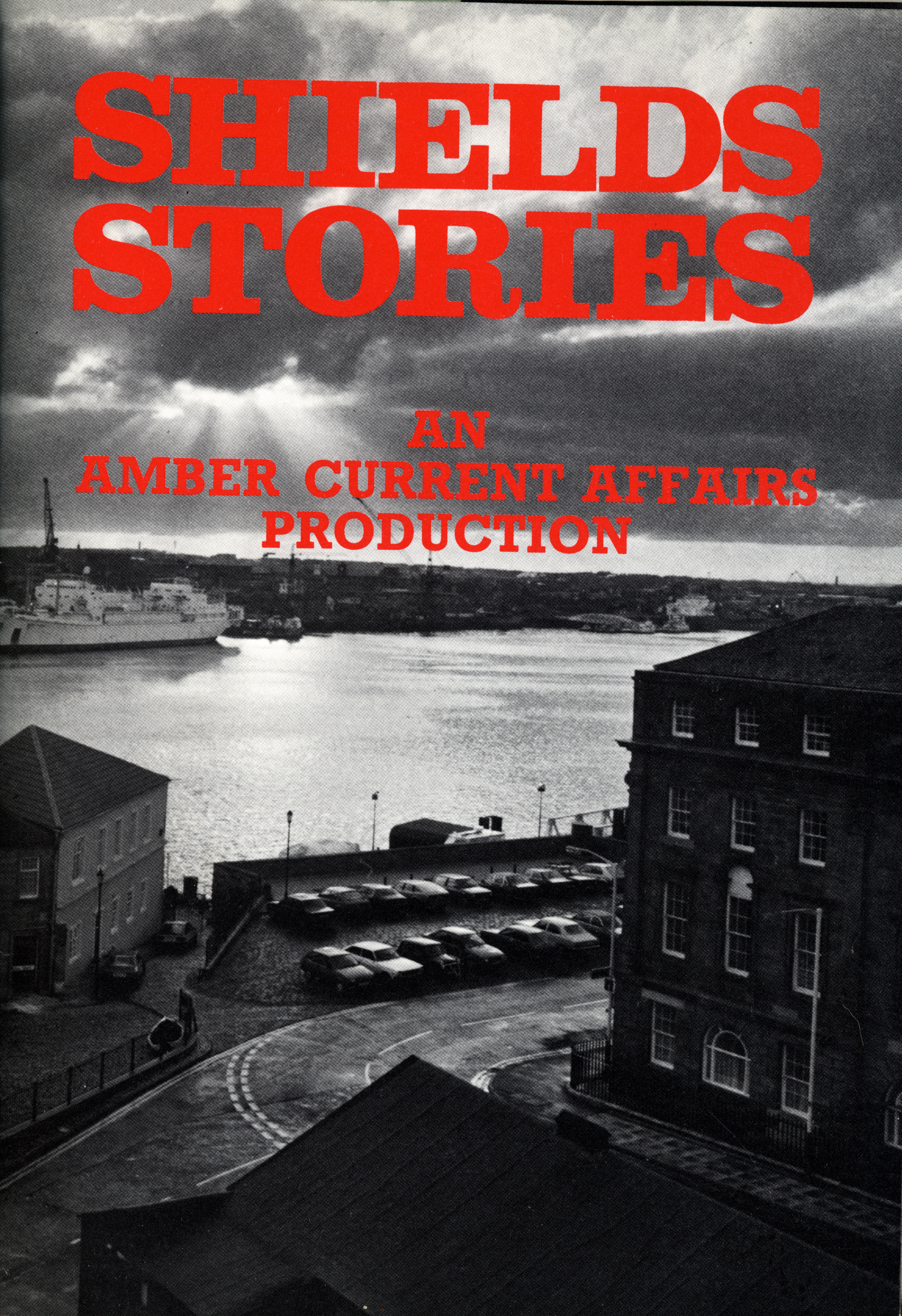
The problem was not so much with the stories themselves. In fact, the series won a number of awards as well as went down in local folklore as one episode supposedly included Robson Green’s first ever TV appearance. The difficulty was that Channel 4 was keen to develop the idea into a much larger project – the first Geordie soap, or as one journalist put it, “the North’s answer to Eastenders” (Fitzpatrick, B., ‘Pub folk help launch a soap’ Evening Chronicle, Dec 18th, 1987). In addition to three features, Channel 4 also requested a 24-part series for a contract apparently in the region of £750,000 (Isaacs, D., ‘£750,000 Tyneside Film Deal’, The Journal, Feb 6th, 1987). While the money and the exposure for the collective might have been tempting, as one of the writers involved pointed out: “The method of working that did successfully work for them, like Seacoal and Dan Smith, wasn’t working with the soap because of that need for continuity, character and development of story over a long period of ten episodes.” (Amber writer 1).
One of the Amber partners was even more unequivocal in arguing against taking the collective in this direction for a number of reasons:
“But it would have meant the only contact you had… if you were turning stuff out on a weekly basis, your only contact with people would be to take from them, it wouldn’t be to give them anything. And if you wanted real people to be performing, again, we’re not interested in shipping in actors to do things, we want people to be representing their own lives, wherever possible. No, you couldn’t, Amber couldn’t have done that, it’s the wrong texture, it’s the wrong thing for Amber, it really is.” (Amber partner 5).

While not all Amber partners and writers agreed with this perspective, neither the money nor the technical support involved in producing a soap format was attractive enough to the collective for them to consider it seriously. Another Amber partner explained the dilemma starkly: “We did decide that we didn’t want to make a soap because we just knew that if we did that it would become a machine that would run us.” (Amber partner 1).
The debate about the soap series was also symptomatic of a wider tension developing in Amber’s work – the relationship between documentary film and feature dramas. Originally Amber made what can only be described as ‘industrial documentaries’. While part of the reason behind this related to their collective philosophy it was also originally related to cost, with documentary being much cheaper to film than drama. With funding from Channel 4 the drama documentary dichotomy began to shift more towards drama. One Amber writer associated with the North Shields Residency recalled a moment where the collective began to experience a “…continuous dilemma between whether they were documentary filmmakers or drama documentary filmmakers.” (Amber writer 2).
Coming soon: Part III will look further at some of these dilemmas and tensions as well as explore the core of Amber’s basic philosophy of making films in conjunction with communities. While it might be argued that films characterising the North Shields Residency became increasingly more drama at the expense of documentary, with the more scripted In Fading Light (1989) and highly dramatic and fantasised Dream On (1991), Amber categorically refused to let go of creating stories with the communities it sought to represent.
Robert Hollands is an Emeritus Professor of Sociology in the School of Geography, Politics and Sociology, Newcastle University. His interest in North Shields stems from his academic interests in urban studies and the sociology of the arts. His connection and affection for the area comes from his wife Carole Wears, who was born in North Shields and stories from his father-in-law, Peter Wears, who was a postman on the Fish Quay for a good number of years.
Read more published research on Amber by Robert Hollands and John Vail:
Hollands R. and Vail J. (2015) Place Imprinting and the arts: A case of the Amber Collective: https://journals.sagepub.com/doi/full/10.1177/0269094215573170
Vail J., and Hollands R. (2013) Creative Democracy and the Arts: the participatory democracy of the Amber Collective: https://journals.sagepub.com/doi/10.1177/1749975513480958
Watch Shields Stories here: https://sidegallery.co.uk/collection/shields-stories-1988