
Interview by S. J. O’Brien
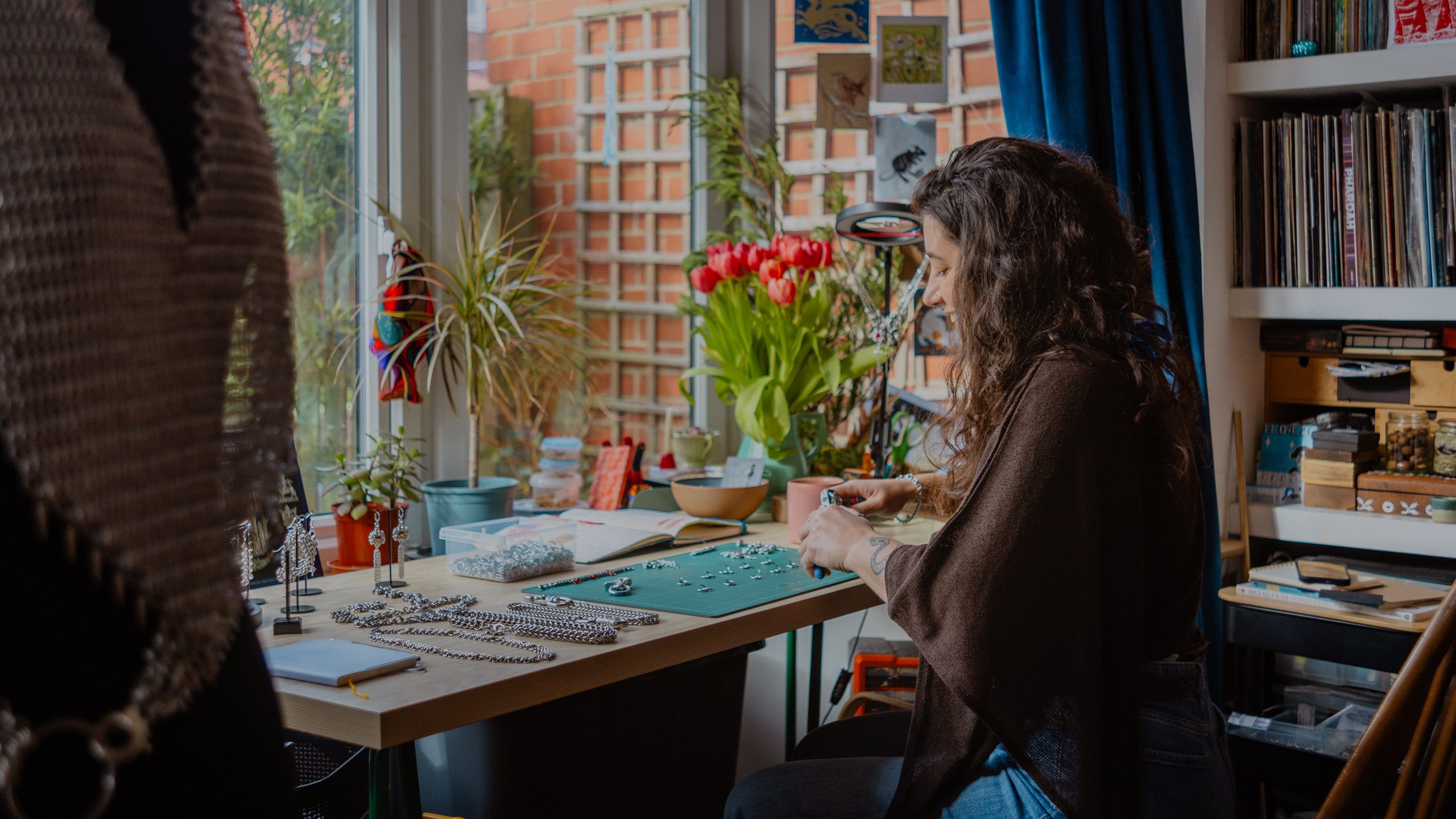
The jewellery artist behind Rindill Makes, Ellie has spent almost her entire life in the North East. Born in Whitley Bay and raised between the Durham Dales and Darlington, she grew up in a family of artists, with a filmmaker and photographer father and a textile artist mother – experiences that helped shape her own creative journey which led her to the traditional craft of chainmail, making jewellery and accessories.
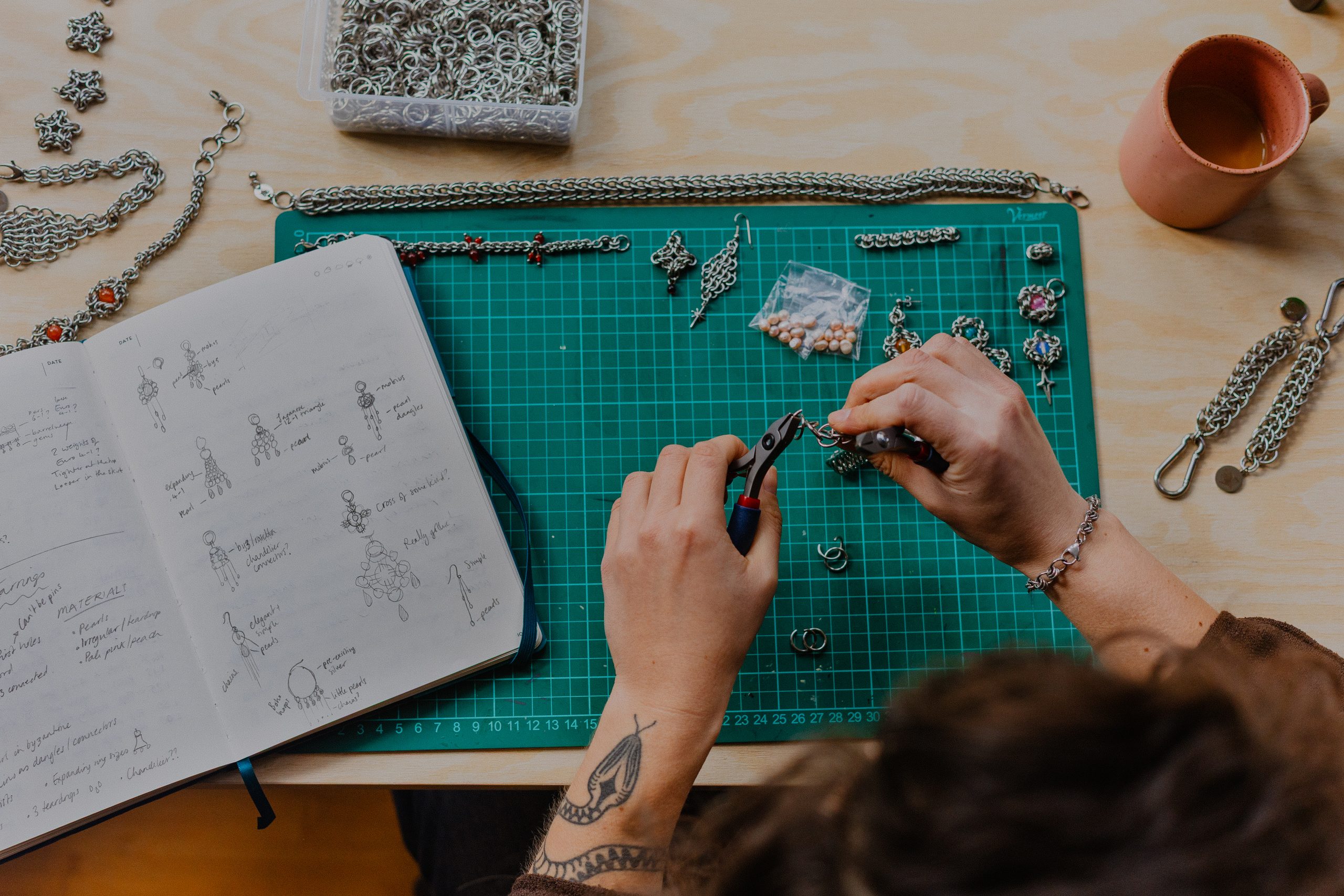
Ellie sells her original chainmail jewellery at fairs, markets, and creative events across the North East, where her distinctive pieces have attracted a growing following among lovers of fantasy and alternative fashion. Drawing inspiration from medieval armour, folklore, and fantastical worlds, she creates intricate handcrafted designs that blend traditional chainmail techniques with contemporary artistic styles. Alongside her jewellery practice, Ellie also leads introductory chainmail workshops, sharing the craft with beginners and guiding participants through the process of creating their own unique pieces. Through both her teaching and her designs, she makes this traditional art form accessible while encouraging creativity, self-expression, and a touch of everyday whimsy.
When did you first start making jewellery, and what drew you to do it independently?
I’ve always been interested in jewellery and enjoyed wearing it, but I’ve never been particularly drawn to what you typically find in shops or to popular trends.
I think I’ve always been a bit of a nerd. We went to some sort of Viking festival when I was a child, and I remember being completely fascinated by a man making a large piece of chainmail armour. There was something compelling about the slow, repetitive process. It’s a historical craft.
A few years ago, I started looking for ways to reconnect with the things I loved as a child, the things that made me who I am. I think when you grow up, build a career, and try to fit into society, you can lose touch with yourself a little bit. So I wondered whether you could buy a kit to learn chainmail. It turns out Etsy sells plenty of them. I bought a bracelet kit because it seemed like an accessible way to get started, and I loved it.
After that, I bought a book about different chainmail weaves, watched YouTube tutorials, and taught myself through curiosity. It was all about asking, “How do you make that? How can I learn the next thing?”
How would you describe your aesthetic as an alternative jewellery maker?
I’m really inspired by jewellery from other cultures. There are so many interesting traditions around the world involving decorative jewellery. Some of it is what we’d describe in Britain as costume jewellery: pieces that are too eccentric, too large, or too dramatic for everyday wear. But I love that. I love the sense of drama, the storytelling, and almost the world-building that comes with it. I own a beautiful pair of silver Amazigh earrings. There’s something about them that feels incredibly rich in history and meaning.
I remember going to the Jorvik Viking Centre and ending up in the gift shop. They had jewellery by another maker, including a simple hammered bronze torque that sat across the collarbone. It was incredibly simple but also such a statement piece. It felt timeless.
For me, jewellery is about how it makes you feel. I’m someone who always has her nose in a book. I’m often lost in fantasy worlds and have always been quite imaginative. I think that fascination with jewellery from different cultures, histories, and traditions comes from that same place.
More generally, handmade jewellery is what really speaks to me. There is so much mass-produced jewellery available, which is absolutely fine, but it’s often treated as disposable in the same way as fast fashion.
So you think about things as being more timeless rather than following micro-trends?
Exactly. When something is handmade, it’s difficult to jump from trend to trend. The time and effort involved become part of the object itself.
Was there a specific moment that sparked your fascination with fantasy and medieval aesthetics?
Have you ever read the Redwall books by Brian Jacques?
The ones with the mice?
Yes, exactly. The ones with the mice.
What I found fascinating about Redwall was its world-building. The Abbey isn’t explicitly religious. It’s more about community, kindness, and treating people well. In some ways it’s very cosy and comforting, but it’s also surprisingly dark at times, with war, death, manipulation, and conflict.
The world completely captured my imagination. I know that doesn’t directly relate to chainmail, but it absolutely shaped my love of fantasy. It introduced me to storytelling that wasn’t constrained by realism and encouraged a deep appreciation of nature as well. Animals and the natural world are incredibly important to me.
Speaking of nature, I remember you mentioning that you recently spent time in the woods during an artist residency. Would you like to talk a bit about that?
I attended an artist residency on Dartmoor. It’s a long way from the North East, but in some ways the landscape felt surprisingly familiar.
One place I was particularly excited to visit was Wistman’s Wood, one of Britain’s last temperate rainforests. It’s an extraordinary place. The oak trees are ancient, twisted, and covered in moss. The woodland sits in a valley, and because it’s protected, visitors are no longer allowed inside. Too much foot traffic would damage the moss and delicate ecosystem. Instead, you walk around the edge and look into it. The shapes of the trees were incredible. I could have stayed there all day. It was one of the most inspiring places I’ve ever visited.
Working with chainmail, your work has an obvious historical aesthetic to it. Are you particularly interested in history – specifically, the palimpsests of history in the North East?
Roman history has always been a significant part of growing up in the North East. It’s everywhere you look.
One thing that really fascinated me was discovering that one of the oldest examples of Roman chainmail found in Britain was discovered in South Shields. It’s on display there, and you can go and see it. That connection to history is really important to me.
Before I started making chainmail, I also went on what was essentially my own artist residency to Orkney to visit Skara Brae. My knowledge of Skara Brae originally came from a children’s book called The Boy with the Bronze Axe, written by someone involved in the excavations during the 1970s. What’s wonderful is that, as an adult, you can actually go and visit these places. Standing at Skara Brae and seeing the bone jewellery people made thousands of years ago was incredibly inspiring. You realise that people 5,000 or 6,000 years ago weren’t so different from us. They had hopes, worries, dreams, and ways of expressing themselves through the objects they created.
Would you work with any other materials, like bone, yourself?
I have been working on a sea-themed collection for a gallery in Berwick-Upon-Tweed. That project gave me an opportunity to think about how different materials could create a connection to the landscape and the sea.
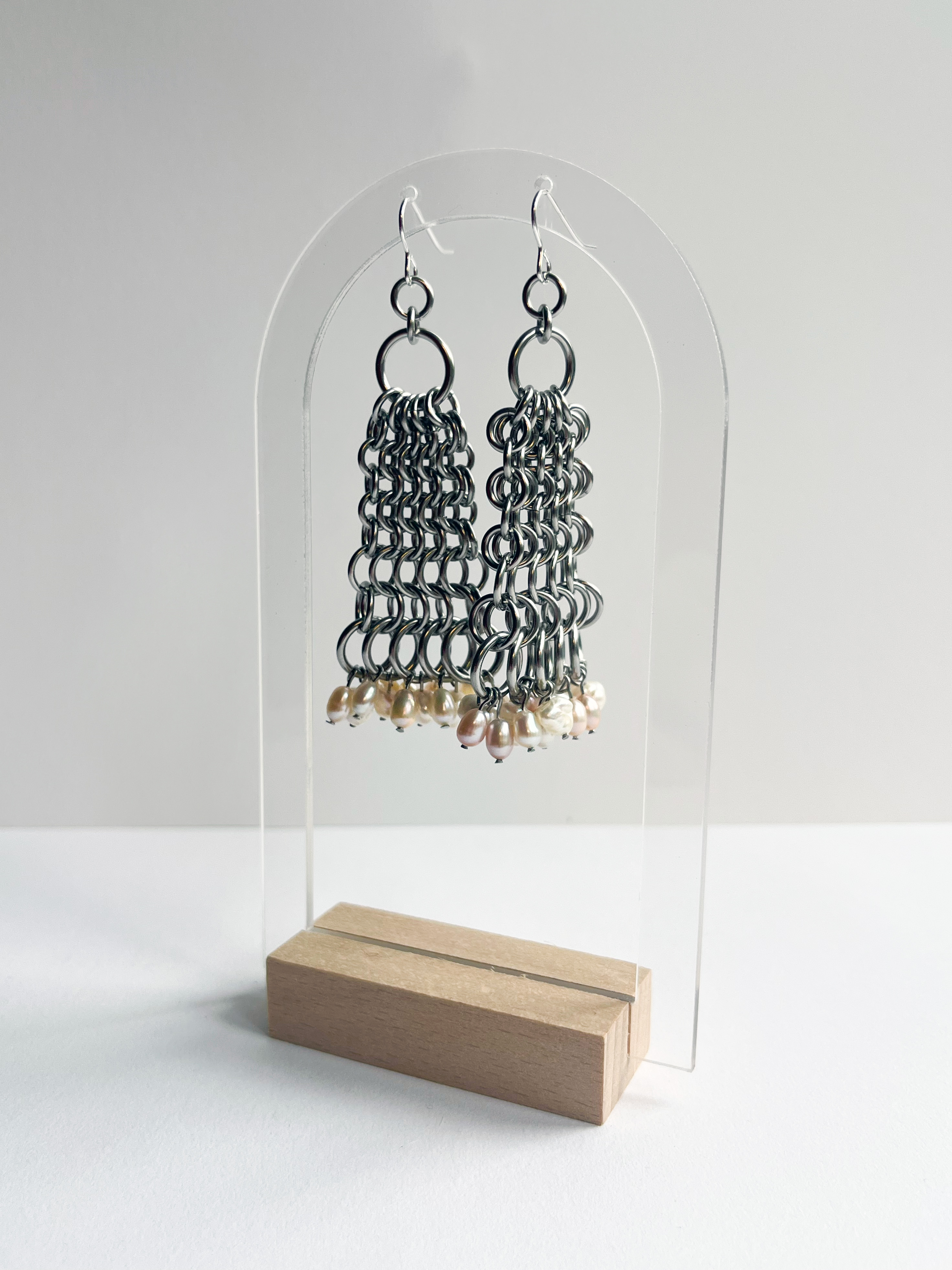
I’ve made a series of earrings using European 4-in-1, which is the traditional Roman chainmail weave. By starting with smaller rings and gradually increasing the size, the weave begins to spread out and flow almost like fabric or a wave. I’ve trimmed some of those earrings with tiny apatite beads. Another version is trimmed with pearls, creating what looks like sea foam breaking along the shore.
I’ve called those the Seafoam Earrings. The design is intended to capture the movement of a wave as it expands and then dissolves into froth.
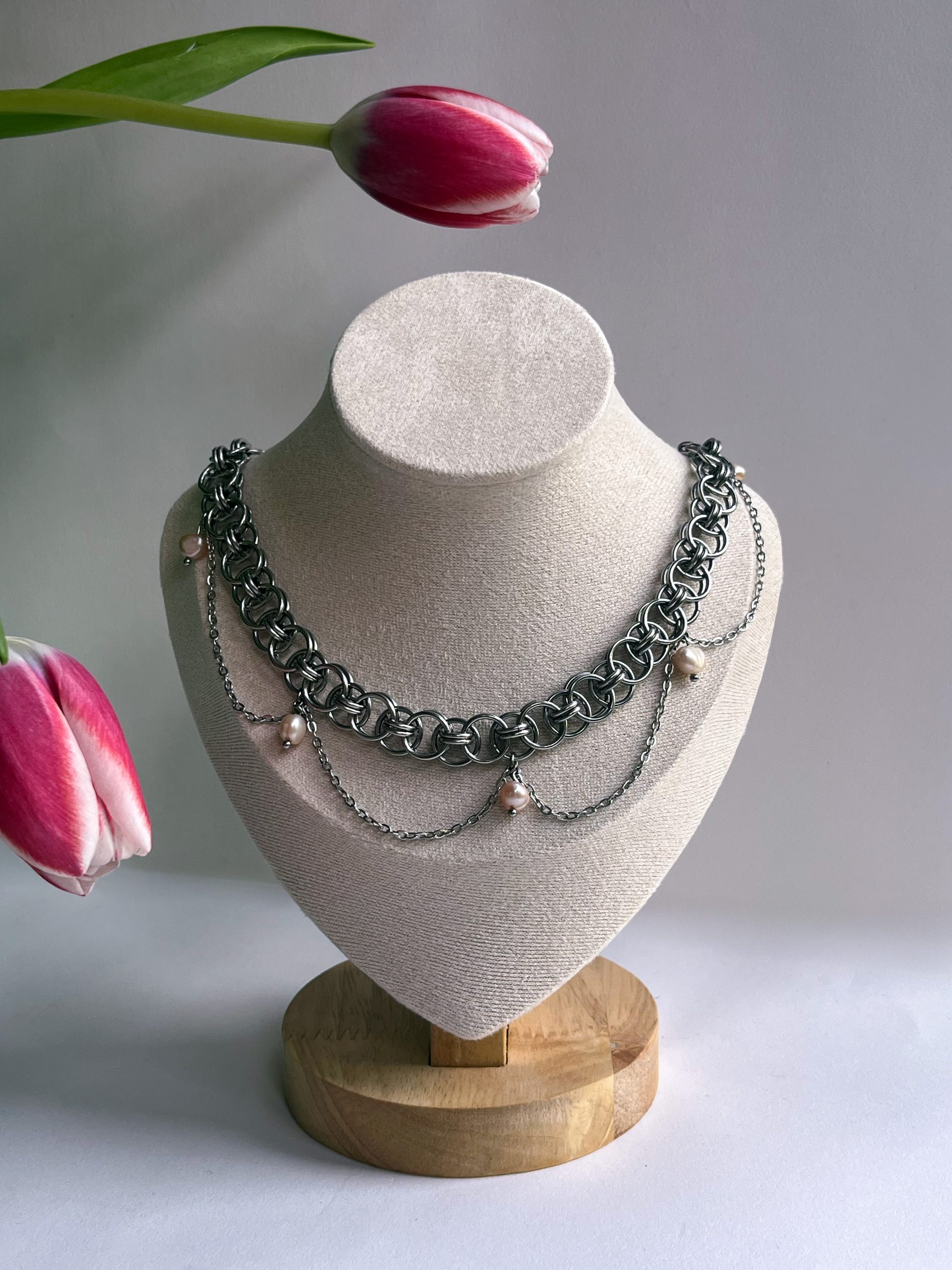
That collection won’t be available online because it’s exclusive to the gallery. However, many of the ideas and materials from it are appearing in other collections that are available on my website. I’ve recently launched a new collection centred around pearls and nature. Much of the inspiration comes from flowers and the floral forms that can be recreated using chainmail techniques.
One component I use is called a Möbius loop. It’s made from rings interlinked in a way that creates a continuous looping form. You can flip it over itself, which also makes it quite a satisfying fidget object. To me, it resembles a rose or a small flower, so I’ve used it in a number of pieces that are all part of a collection called Posy.
I’ve also been working with a weave called Byzantine, which can be turned into a structure called a Romanov unit that holds a gemstone in the centre. Instead of gemstones, I’ve been using pearls. I combine those pearl-centred units with the Posy motifs to create earrings, necklaces, and bracelets that work together as a coordinated set. That collection is called Bloom, because the pieces resemble flowers opening around a luminous pearl centre.
Regarding concept, how do you translate something abstract, like a legend, a myth, or a fantasy world, into wearable jewellery? What does that process look like for you?
Honestly, it’s a very vibes-based process.
One thing I’d love to explore further is creating pieces inspired by specific mythical or fictional characters. A creator I follow takes characters from fantasy, folklore, or popular culture and creates necklaces inspired by them. The jewellery doesn’t literally resemble the character. Instead, it captures their colours, textures, and overall feeling.
I haven’t gone that far yet. For me, it’s more about trying to capture a feeling or atmosphere than directly referencing a character.
Is there a chainmail technique you’ve learned because of its historical importance?
Most of the weaves I use create chains, whereas European 4-in-1 creates a sheet or fabric. That’s what makes it suitable for armour, clothing, and larger pieces. People often describe it as a beginner’s weave, but I actually think it’s quite challenging because it requires an understanding of orientation and movement. I’ve spent years developing my own understanding of how it functions, and I’m still learning.
You’re getting into workshops and teaching now. Can you tell me more about that?
I started teaching workshops about six months ago, and they’ve been going really well.
A lot of effort goes into breaking the process down into manageable steps. Learning chainmail isn’t just about learning a weave. If someone has never used jewellery pliers before, that’s a learning curve in itself.
So far, I’ve focused on projects that allow participants to create a finished piece during the session. I think it’s important that people leave with something tangible and feel a sense of achievement. One of my most popular workshops teaches a spiral weave. It looks incredibly impressive, almost like a DNA helix, but it’s actually very beginner-friendly. Later this year I’ll be teaching a Byzantine bracelet workshop, and then, at Christmas, I’ll finally be teaching a European 4-in-1 chainmail pennant tree decoration workshop.
Do you ever see yourself creating pieces for special occasions, like weddings or anniversaries?
Absolutely. I would love to do more of that.
I recently made a custom pair of earrings for a friend’s wedding. The design incorporated pearls and was tailored specifically to complement the pearls she was already wearing. Creating something bespoke for such an important occasion was really special, and I’d love to explore more commissions like that in the future.
How do you balance creativity with the business side of things?
It started as a creative pursuit, and that’s the reason I got into it.
When I started doing markets, I realised I needed a product range that was repeatable. I still try to introduce something new at each market so returning customers can discover something different, but I also maintain a core range of pieces.
What has really helped is stepping away from it occasionally and then coming back with fresh ideas. I’ve also started treating creative development and stock production as two separate tasks. Setting aside dedicated time for experimentation, rather than constantly producing stock, helps me maintain that sense of freedom.
What platforms or communities have helped you reach your audience as your business grows?
I started on Instagram, and at first it was mostly friends supporting me, which was lovely.
But honestly, all of those things feel secondary to meeting people in person. Markets have been amazing for finding new audiences and building relationships with customers. Organisations like I Love North Shields have been fantastic.
More broadly, the network of women running small businesses across the North East has been hugely influential. People genuinely want to support one another, and that’s what has opened doors and created opportunities for me.
Is there a piece you’ve made that feels especially personal to you?
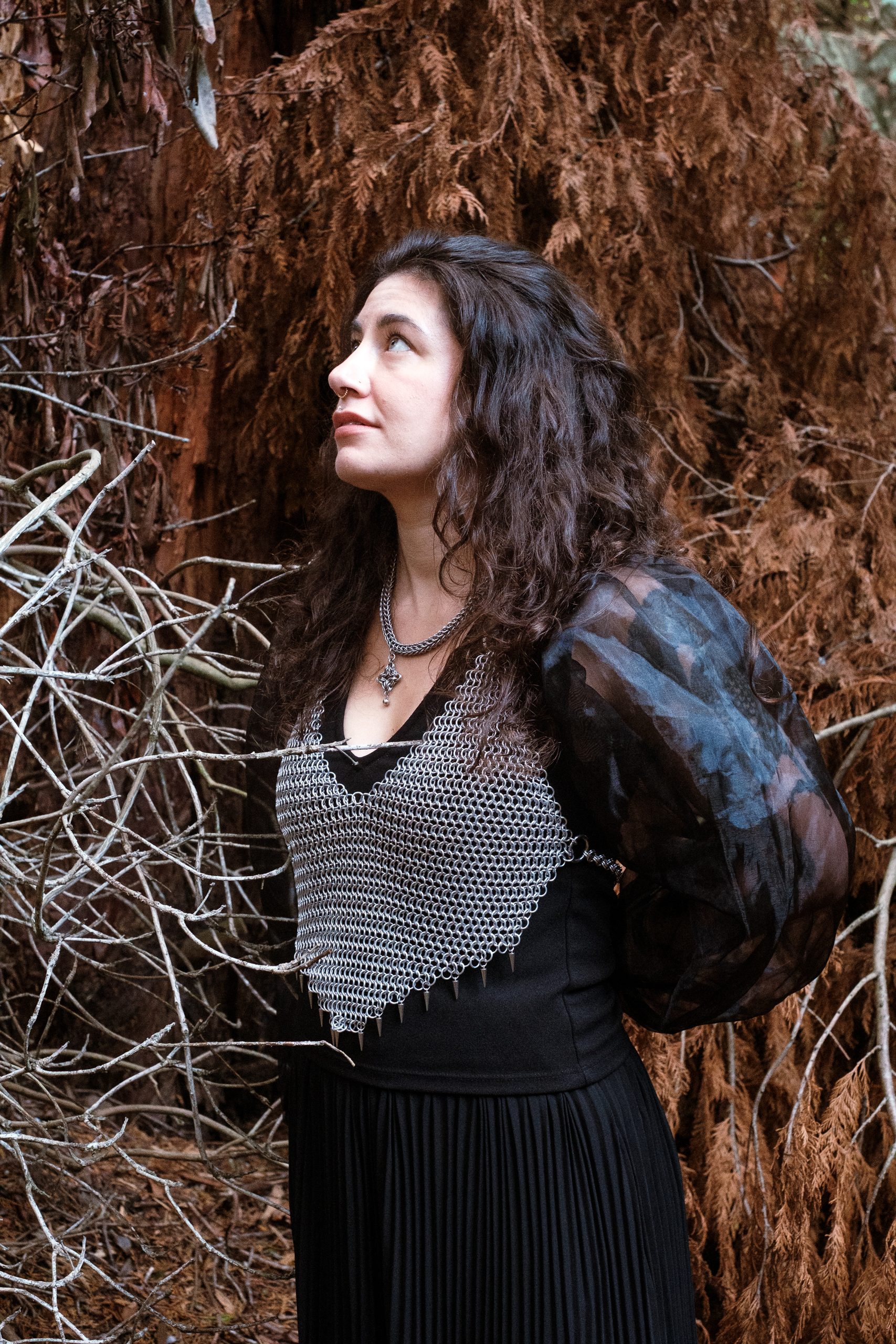
It’s actually the necklace I’m wearing right now. I originally made it to sell, but I enjoyed wearing it so much that I decided to keep it. It’s made using a Full Persian 6-in-1 weave. I came across images of something called a Byzantine Diamond and thought, I wonder if I can work out how that’s made. Instead of looking up a tutorial, I studied the photographs and reverse-engineered it myself. It was the first time I’d successfully done that.
That moment felt really significant. It was a sign that I was becoming more familiar with the craft. It felt like levelling up. And it works quite well as advertising too. The other day I was at the arts centre buying some craft supplies before a meeting, and one of the women behind the counter recognized it.
She said, “Oh, where did you get your necklace?”
I told her I’d made it, and she replied, “Oh, are you the chainmail woman?”
You’re becoming recognisable!
To learn more about Ellie’s work, explore her latest collections, or commission a bespoke piece, visit the Rindill Makes website at www.rindillmakes.co.uk. You can also follow her creative journey on Instagram at @rindill.makes, where she shares new designs, behind-the-scenes glimpses of her process, and upcoming events. For regular updates on new jewellery, market appearances, and workshop releases, sign up for the Rindill Makes newsletter at https://www.rindillmakes.co.uk/newsletter.
If you’d like to experience chainmail craftsmanship firsthand, Ellie will be running an Introduction to Chainmail Jewellery: Helm Chain Workshop in Hexham this September, as well as a festive Chainmail Christmas Pennants Workshop at Newcastle Arts Centre in December. You can also find her jewellery in person at a range of markets throughout the year, including the I Love North Shields Vintage Markets in October and December, The Night Market UK in North Shields on September 4th, and events in Ouseburn throughout November and December.