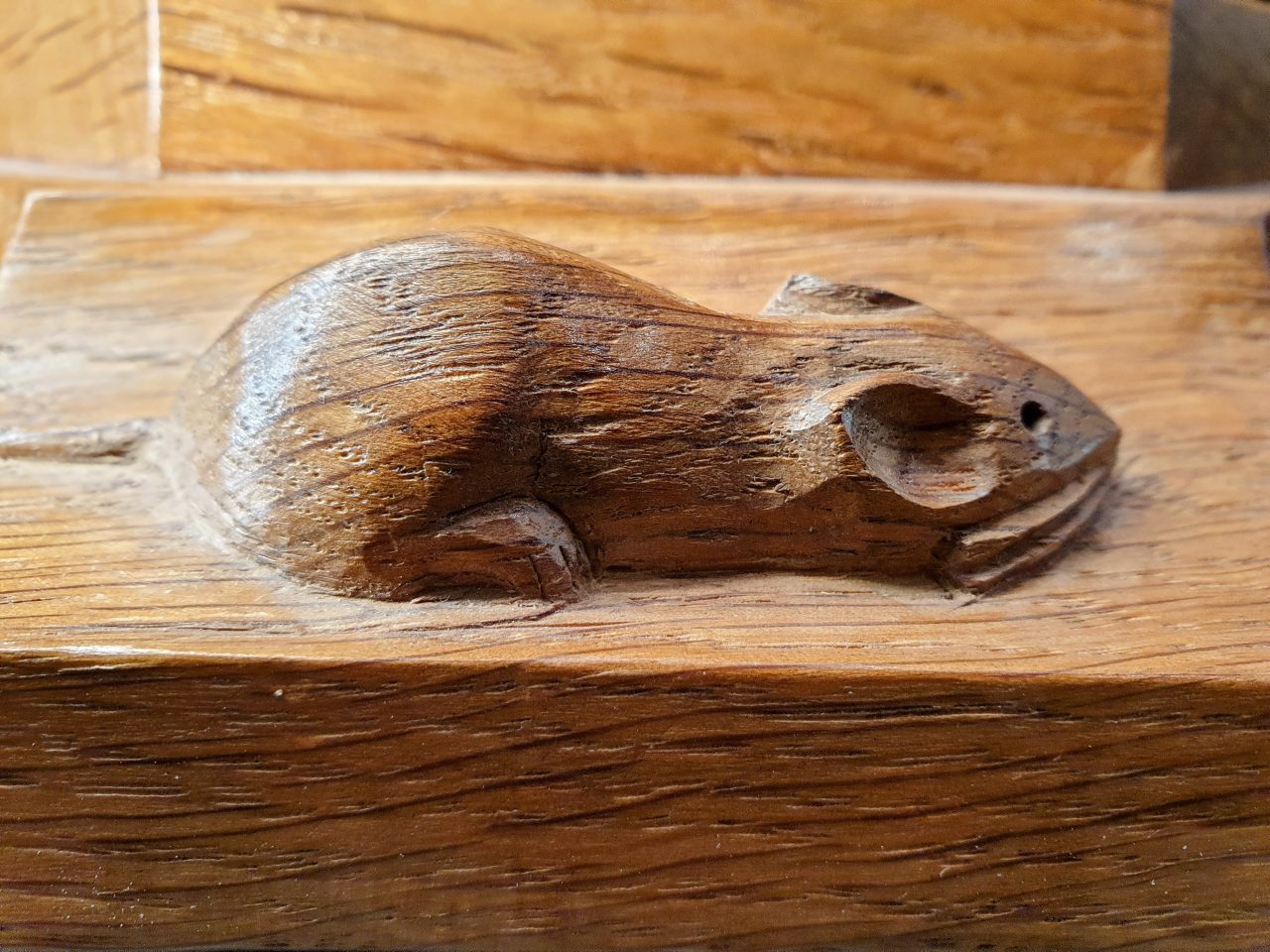
Few British craftsmen have a signature as instantly recognisable — or as quietly subversive — as Robert “Mouseman” Thompson. His mouse, carved discreetly into the leg of a chair or the base of a lectern, has become a coded marker of authenticity: a tiny creature signalling the presence of one of the finest woodwork traditions in 20th-century Britain.
This article examines Thompson’s life and practice, the philosophy behind his mouse trademark, the evolution of the Kilburn workshop, and — crucially — how pieces from his workshop found their way into North Shields, where they remain today inside St Columba’s United Reformed Church and in the form of the 1958 Wooden Dolly originally sited in Northumberland Square.
This is not a local curiosity. It is a cultural link between Tyneside and one of the most rigorous, historically rooted craft movements of the last century.
The Maker: Origins of a Craftsman in Kilburn
Robert Thompson (1876–1955) was born in the small Yorkshire village of Kilburn, an area defined by rural labour rather than artistic legacy. His early training as an engineer — which he later described as “five years of penal servitude” — shaped his lifelong distrust of industrialisation. On returning to Kilburn, he joined his family’s woodworking enterprise and began developing a craft philosophy that rejected mechanisation and privileged hand labour, devotion to material, and visible workmanship.
His influences were medieval: church screens, misericords, and monastic furniture whose beauty depended on structure, not surface ornament. He embraced traditional joinery and worked almost exclusively in English oak, believing its density and grain expressed the moral value of honest labour.
By the 1920s, Thompson’s workshop was receiving major ecclesiastical commissions across Britain. His work was distinct not because it was elaborate, but because it was uncompromisingly handmade — a rarity even then, and almost unthinkable now.
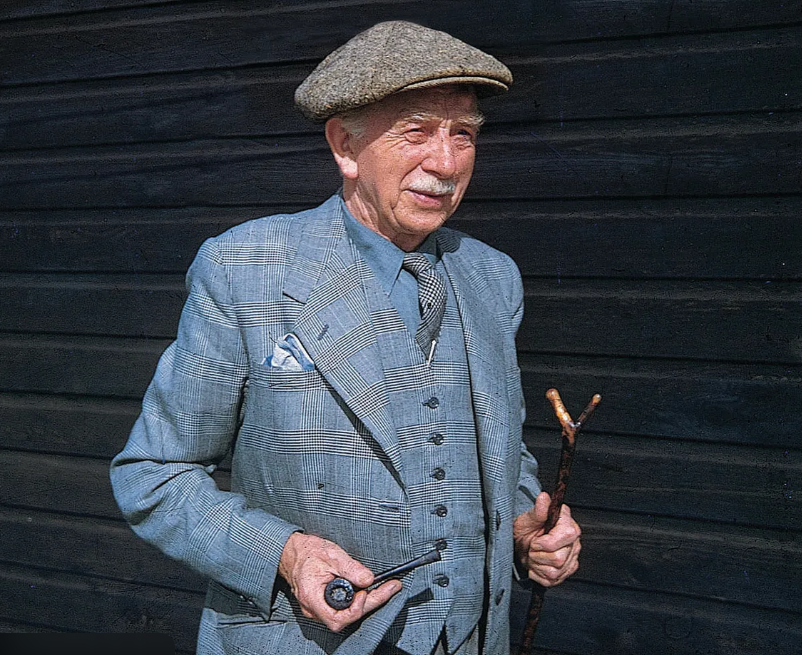
The Mouse: A Signature Born from Working-Class Humour
The origin of the mouse is simple yet profound. During a commission in the early 1920s, a fellow craftsman remarked that they were “as poor as church mice.” Thompson, amused, carved a mouse onto the piece he was working on. It was not a planned artistic flourish but an instinctive gesture — one that Thompson immediately recognised as a mark of authorship.
From that moment, every piece produced in his workshop carried a mouse:
- carved entirely by hand
- no two identical
- never placed for decoration, but for quiet discovery
- always positioned where the form of the furniture allowed a mouse to appear “naturally”
This individuality elevated each object from furniture to personal artefact. The mouse was not branding — it was a declaration of responsibility. It said: a human made this, slowly, with intention.
Methods, Tools, and the Kilburn Style
Thompson’s approach was defined by:
Adzing
Rather than sanding wood smooth, Thompson worked surfaces with an adze, leaving a shallow, faceted texture. This technique — rarely used in modern furniture — produces shimmering surfaces that react beautifully to light.
Joinery
He retained medieval construction: pegged joints, through-tenons, and visible structural honesty.
Material Selection
English oak was not simply his preference; it was his statement. Dense, slow-growing and symbolically “English,” it tied his work to the land.
Workshop Discipline
Each craftsman was expected to carve their own mouse, subtly distinguishable by style. This practice created an internal lineage of makers whose hands can often be identified by specialists.
After Thompson’s death in 1955, his workshop — Robert Thompson’s Craftsmen Ltd — continued his methods. The firm retained hand tools, maintained the mouse tradition, and preserved the adzed finish. It remains one of the few craft workshops in Britain still operating with near-medieval discipline.
Mouseman in North Shields: A Significant but Overlooked Presence
St Columba’s United Reformed Church
Inside St Columba’s, on Northumberland Square in North Shields, stands a suite of furniture attributed to the Mouseman workshop:
This is not decorative furniture. It is part of a national craft heritage, placed quietly in a North Shields church built by John Dobson and rooted in 19th-century architecture. The presence of Mouseman work here speaks to the high standards once expected in civic and religious interiors.
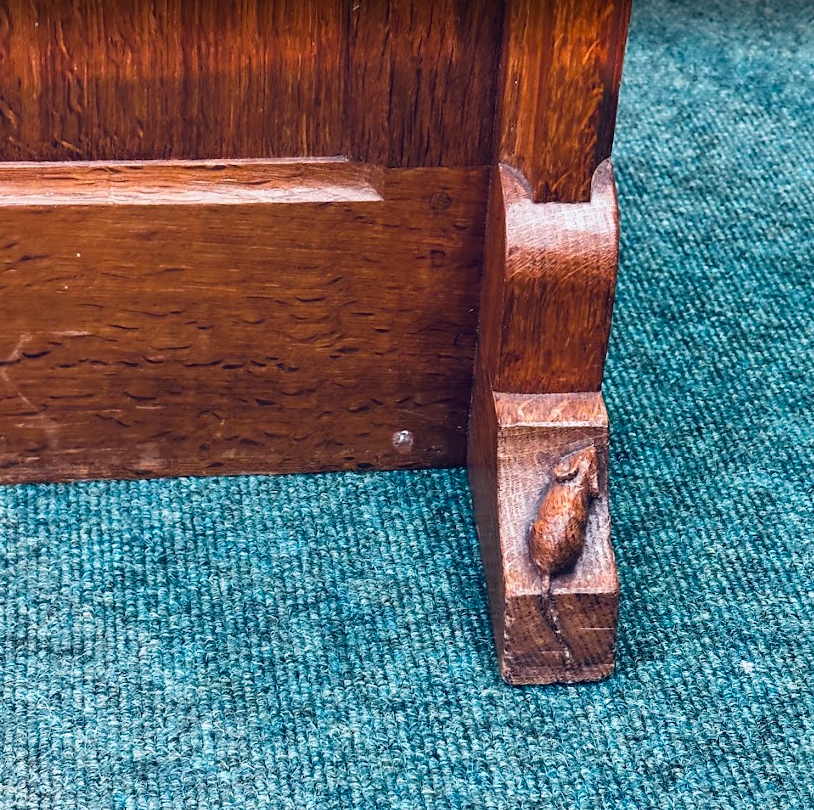
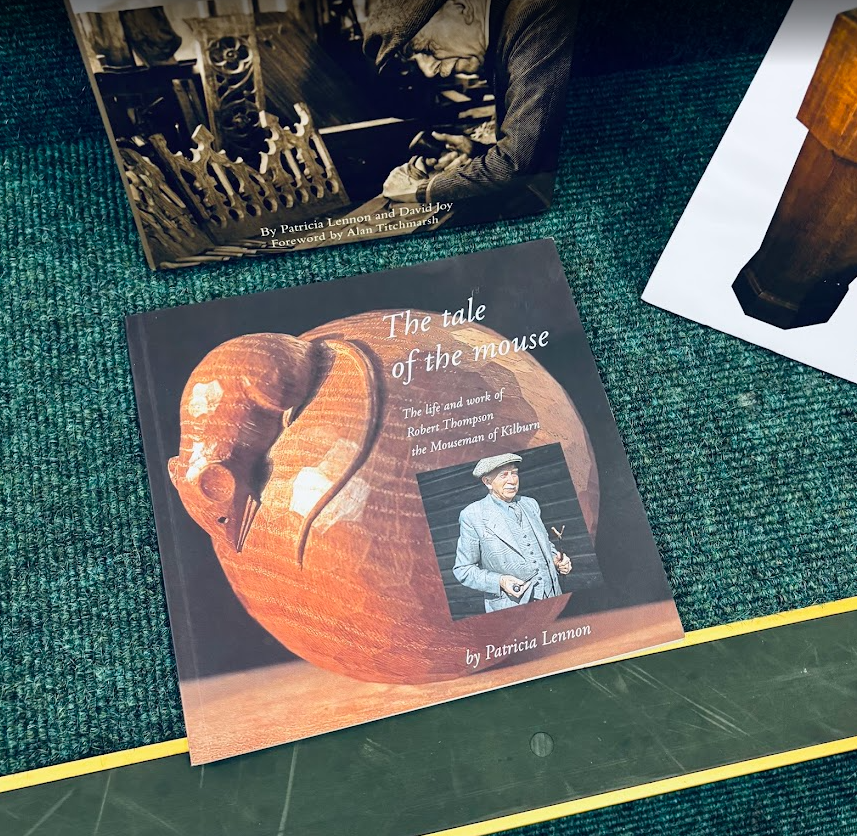
These placements match those documented in Kilburn’s ecclesiastical commissions for Ampleforth, Manchester, Bolton, and others.
Why this matters
The survival of Mouseman furniture in St Columba’s places North Shields within a national network of ecclesiastical craftsmanship. The church, publicly accessible, now holds one of the region’s most quietly important craft collections.
The 1958 Wooden Dolly, Northumberland Square
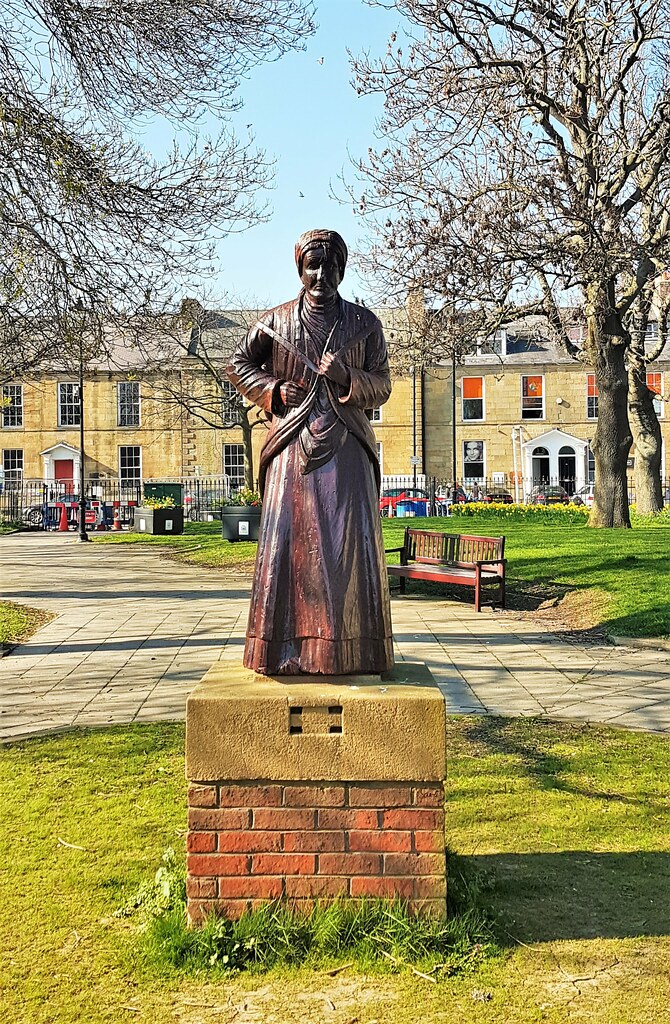
North Shields’ long tradition of Wooden Dollies — carved female figures historically used as nautical memorials — took an unexpected turn in 1958 when the replacement Dolly was carved by Robert Thompson’s Craftsmen Ltd.
This commission is significant:
- It indicates that the Thompson workshop was trusted beyond church contexts.
- It brings a rural Arts-and-Crafts lineage into the civic identity of North Shields.
- It ties the Dolly to one of Britain’s most recognisable craft traditions.
The Dolly originally stood at North Shields Library and is now documented by Art UK as a Thompson workshop piece. While Dollies are normally regional folk artefacts, this one uniquely blends maritime symbolism with Yorkshire craftsmanship.
What the Mouseman Connection Says About North Shields
Heritage is rarely built by grand gestures. It’s formed in the small, often unnoticed details: a carving under a lectern, a figure standing quietly in a square.
North Shields’ relationship with the Mouseman workshop reveals several truths:
- The town valued high craftsmanship during mid-century church refurbishments and civic commissions.
- Local heritage is interconnected with national manufacturing stories.
- Our buildings and public spaces contain museum-grade craftsmanship that many pass daily without realising its significance.
- These objects reinforce the town’s role in the larger narrative of English decorative arts.
Mouseman carvings in St Columba’s and the Wooden Dolly in the Square are not isolated artefacts — they are part of a broader continuum of craftsmanship, faith, identity, and public art.
Toward Preservation and Interpretation
Both the Mouseman furniture and the Wooden Dolly deserve formal recognition and conservation. Thompson’s works are now considered collectible, academically studied, and historically valuable. Many churches have had their Mouseman pieces stolen or damaged over time — making the survival of these works in North Shields particularly noteworthy.
There is potential for:
- heritage trails
- conservation partnerships
- interpretive signage
- community arts links
- collaboration with the Kilburn workshop
Such steps would elevate these pieces from quiet curiosities to celebrated assets of North Shields’ cultural identity.
Conclusion
Robert “Mouseman” Thompson’s carved mice were never intended as branding. They were a maker’s declaration — a sign that the piece beneath your hand was shaped through skill, patience, and devotion to craft.
The fact that North Shields holds not one but two threads of this legacy — the ecclesiastical furniture of St Columba’s and the 1958 Wooden Dolly — places our town within a rare and valuable lineage.
The mouse carvings are small. Their significance is not.
They tell us that North Shields is part of a national story of craftsmanship, faith, labour, and artistry — and that some of the country’s finest handmade objects live quietly in the heart of our town.