By Robert Hollands
‘…it [North Shields] had what we call the third dimension, which was that it was a visually striking place, high above the river in the main, but also it was a residue of a particular type of industrial community (…) we felt, really, I felt – and this sounds absolutely crazy – but I felt it was the sort of place you’d be quite happy to die in’. (Murray Martin, Amber Heritage Project Interviews, 2004).
This article was originally intended to be a chapter in a book about Amber with my colleague John Vail when we both worked in Sociology at Newcastle University. While we wrote numerous academic articles on the collective, funded by the ESRC, unfortunately we never finished the book. We conducted 57 in-depth interviews with partners, associates and employees of Amber, related personnel working in the arts and TV. The Amber Heritage Project Interviews were funded by the Heritage Lottery Fund and Northern Rock Foundation. Thanks to the collective for providing us with full transcripts of the interviews and particularly to Sirkka-Liisa Konttinen for allowing us access to her historical scrapbook material. All interviews conducted by us have been anonymised. As such, we refer to our interviewees numerically and we also distinguish between Amber partners (members who owned the partnership) and associate members (i.e. Amber associate 1 or Amber partner 1, etc).
The article will be published in three parts. In Part I, we deal with some of the reasons behind Amber’s move, and why North Shields, in particular, was chosen as a location.
In 1986 the Amber Film and Photography Collective decided to relocate its artistic focus from Newcastle to North Shields, a nearby town further along the river Tyne. This period (1986-1991) became known as the ‘North Shields Residency’, a highly productive and innovative part of the group’s history. The decision was motivated by a desire to return to their original concern on working with and representing working-class communities artistically, as well as freeing the group from a busy and somewhat entrenched organisational routine. As the opening quotation shows, the decision to ‘up sticks’ to North Shields was not only philosophically and aesthetically motivated but was also quite emotional in character. As such, it also reveals something about the character of North Shields itself.
The North Shields Residency period tells us not only about the Amber collective’s dilemmas about maintaining their core artistic philosophy, but also their desire to improvise their practice to account for social change. For instance, the move was clearly an attempt for the group to ‘shake things up’ organisationally. As such, this is a period where they took various risks and gambles, such as buying a pub and a fishing boat to authentically set their films in. Taking on new writers into the group, they also struggled with the dilemmas and tensions of the drama documentary form as well as the creation of a women’s group within the collective.
At the same time, the residency was designed to return to the group’s core philosophy of representing working class communities artistically in film and photography. This included the desire to physically move and live within the place they were documenting, and the need to engage in a creative dialogue with a community in terms of telling their stories. While part of the motivation for the North Shields move was to ‘get back to basics’, the scaling up of their creative work during this time did not always solve the problem of the collective being stretched and sometimes internally divided in terms of whose stories were being told.
The North Shields Residency
Prior to examining some of the reasons why Amber chose to refocus its artistic gaze on North Shields, there are a number of broader social conditions to be considered. At the most basic level, was a desire in the collective to re-connect to a discernible working-class community. However, behind this simple explanation lie deeper factors such as urban change, industrial decline (including the effect of the miners’ strike), as well as organisational change within and around the collective, in terms of its growth in numbers, activities, and networks, not to mention changes in the wider film and TV industry.
Factors behind the move
Regarding the desire of the collective to work with a recognisable working class community, in the words of one member: ‘We were looking for a community that still had the kind of traditional sense of itself’ (Amber partner 1). Part of this need to re-connect was a realisation that Amber had exhausted its initial links with working class Byker, the first community it rooted itself in when it moved to Newcastle in the early 70s. By the mid-1980s the area had changed out of all recognition with the demolition of the old working class neighbourhood and housing and the displacement of most of the people. The building of the Byker Wall also changed community relations fundamentally. Urban change and economic restructuring in the region also meant areas the collective had once worked in, like Wallsend, where Launch (their 1973 film about shipbuilding) and Wallsend Festival (a 1972 film about a shipyard marching brass band and a juvenile jazz band) were made, had also experienced drastic post-industrial economic decline. (Amber returned to work in later years with schools and the community in Wallsend as part of its Learning and Participation programme funded through a Heritage Lottery grant (gained in 2014), including reuniting members of the juvenile jazz band. Their education work continues in schools including North Shields, demonstrating their circular gravitation towards documenting social change in working class areas.)
Newcastle city centre itself was also undergoing significant urban change in the 1980s. Based on the Newcastle Quayside, Amber was involved in preserving the character of the area by engaging in a project to save a number of architecturally significant buildings. They also made a film of the area called Quayside (1979) emphasising its industrial history, as well as worked hard to create a space for alternative cultural organisations to locate there, like Live Theatre. However, there was a growing recognition within Amber that ‘artistic regeneration’ could be a victim of its own success, which went against their fundamental philosophy to be accessible to its working class audience. As one filmmaker associated with Amber told us:
‘I think at a certain point that Murray in particular, and Murray and Amber, at around the time I left, I think they began to get frustrated at this thing that existed on the Quayside, and really their interest lay in North Shields or in Newbiggin or in Easington and that they wanted to reach out… and you were never going to get working class people from North Shields coming to the Side Cinema or the Side Gallery unless it was a special night out and it was something about them’ (Amber associate 1).
Not only were urban areas changing in the North-East, but so were the working class communities that once inhabited them. The decimation of industrial communities in the 1980s by the Conservative government was perhaps most well represented by the significance of the defeat of the miners in 1985. Amber recognised that not only were the miners beaten, but that the defeat of the strike was a major blow for both the artistic left and the working class communities that they were documenting. Even though the Collective always insisted that they were not strictly ‘party political’, this event impacted heavily on the group, their artistic practice, and the communities that they worked with. As one Amber partner explained: ‘I think we all suffered from that after the miners’ strike, trying to find a way forward politically if you like, and I think within the Amber group there was a lot of debate and there was an awareness that it wasn’t as simple anymore, it’s not just a class struggle anymore, and that we had to find other ways’ (Amber partner 2).
The impact of these various changes on the group and their practice in the mid-80s was not straightforward. On the one hand, urban transformation and shifts in class politics may have meant that doing the type of creative work Amber had always done had become more difficult. On the other hand, such changes may have had the effect of actually strengthening the collective’s resolve to seek out and document (albeit) working class communities before they literally disappeared. The fact that Amber chose not to go on and document the mining communities they supported during the strike (for example their involvement in the workshop movements, Miners’ Campaign Tapes, and their 1985 Making the News), may have been partly because the experience of loss immediately after the defeat was just too raw. Although it is worth noting that the group did return to making a trilogy of films set in the Durham coalfields in the 90s and beyond. Additionally, the collective was always interested in not only documenting workplace politics, but what industrial work (and its loss) meant for the wider community.
In addition to these factors, more immediate institutional forces also had a part to play in Amber’s idea to ‘up sticks’ and re-connect to a discernible working class community. The collectives’ relative success in gaining funding through Channel 4 workshop sources had some unintended effects. For example, as a later Amber associate, Graeme Rigby explained: ‘If you look at the history of Amber what you can see is a massive expansion of activity and that’s when the Collective grew in scale, when it moved towards doing feature films in 1985. The ambition of the films increased, the level of the work increased.’ (Newsinger, J. ‘Together we Stand’, Vertigo Issue 11 | August 2007). One effect of this success was that the pressure to produce for Channel 4 meant that the group began to feel that they were losing touch with the very people who they were making films for.
In order to cope with the work, Amber also grew in numbers during this period, developing a range of networks (with writers, photographers, councils, trade unions, etc) and reorganising itself into a number of production units. It also took on a number of new members and associates (linked but not full members), to cope with the increased workload.In addition to taking on a number of new writers into the collective during this period, Amber also recruited some new partners and members who might also be seen as part of a general ‘shake-up’ within the organisation. Pat McCarty, a community activist, brought political knowledge of North Shields, Richard Grassick was involved in trade union media politics, and Elaine Drainville was engaged with issues surrounding the Greenham Common peace camp. As such, they all brought new political dimensions to Amber’s work, and not surprisingly all three were involved with setting up a Current Affairs Unit within Amber.
This solution however, had other unintended effects on the collective. The first one was the sheer amount of work it continued to take on, leaving less time for ‘creative labour’ (actual film-making):
‘I think, after the gallery and cinema were developed (…) there was photography work being shown, photographers coming in, we got filmmakers coming in to show their work, and there was a cinema to run, and more and more of what had been originally creative time was being absorbed by having to bolster up the activities, and that became kind of self-defeating in a way’ (Amber partner 3).
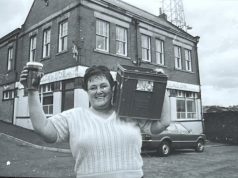
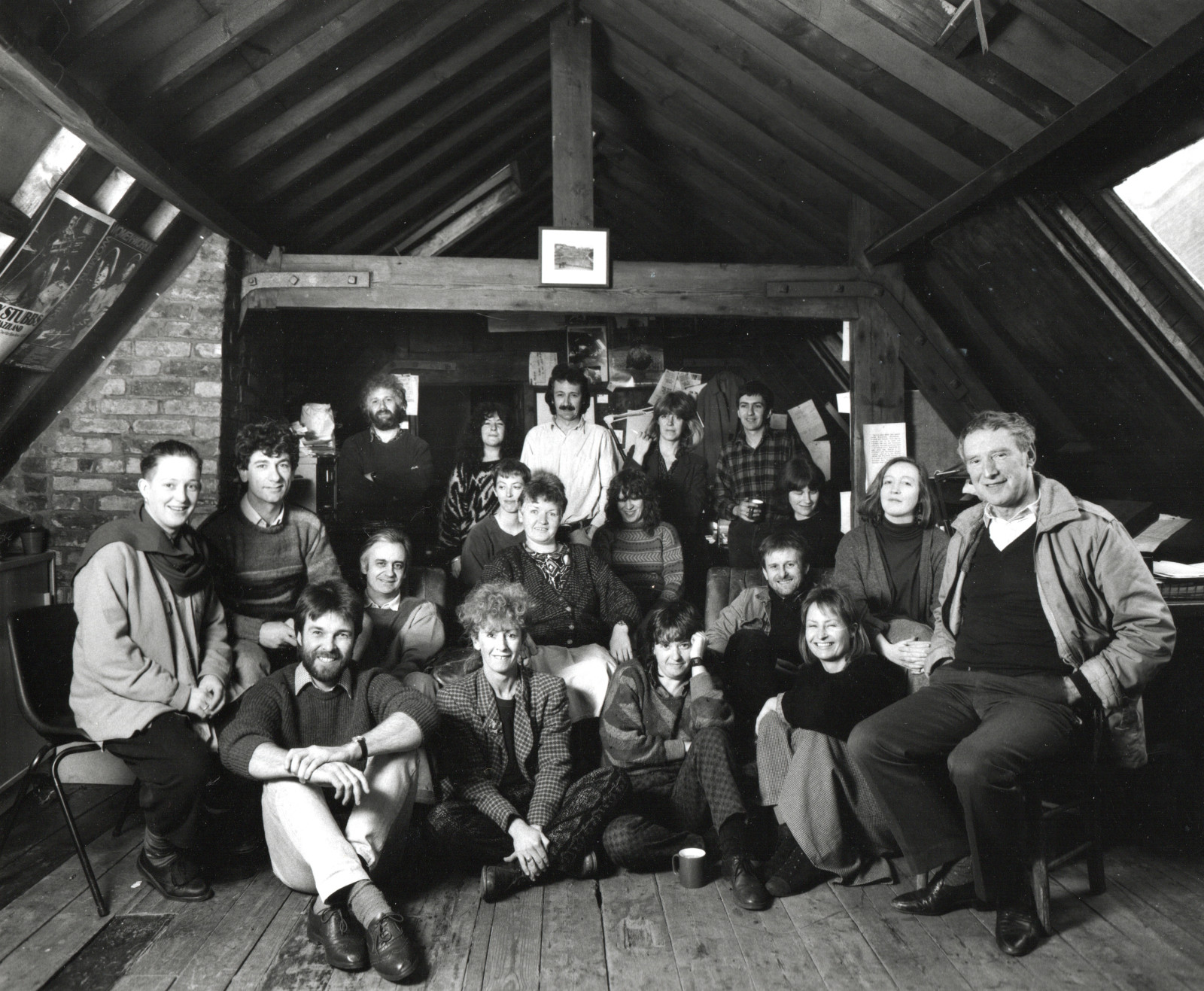
The problem created here was the issue of the size of the collective in terms of decision-making. Various Amber partners we interviewed said the ideal size of an arts collective was under ten. In the mid-eighties however, Amber and its various associate members had grown to nearly twenty people (see Image 1), and some felt that was too large for the collective to work. There was a growing belief that the group had got ‘too big’ and ‘needed to come together again’, not just in terms of a single project, but also geographically. As one Amber partner expressed: ‘…it was a bit like reverting to what the original group had been’ (Amber partner 4).
There was one further organisational factor behind the group wanting to geographically re-focus itself, and this involved Amber’s improvisational spirit that believed in creating purposive disruptions to loosen the grip of organisational routine and to create new ideas. More specifically, this desire to innovate appeared to come particularly from one of the founders of the collective, Murray Martin, according to one Amber member:
‘I think he liked to shake things up in his own comfort zone. I think that’s the reason… the practice and the way in which Amber worked, or we all worked, was consistent all the way through, but I honestly think that the shaking-up was done because Murray would get bored (…). If Murray started feeling that there was a void, that the pool from which you draw ideas was getting less and less, there would be a shake up’ (Amber associate 2).
As we will later go on to document in Part III of this article, this sometimes involved taking ‘risky’ decisions – like buying and running a pub, purchasing a fishing boat to shoot scenes on, experimenting with the drama documentary form, or creating a women’s production group within the collective. Part of Amber’s attempt to ‘shake things up’ also included taking on new members and new challenges. Yet, it is important to note that such innovation and recruitment always took place within the context of Amber’s underlying philosophy – stretching but never completely breaking its limits.
Why North Shields?
‘The attraction of North Shields is that it is a traditional long established working class community.’ Murray Martin quoted in Wright, K. (1986) ‘Shields Film Project, Town to Be Star’, North Shields News Guardian, March 23rd.
Following the release of their first feature film Seacoal in 1985 for Channel 4, the Amber collective found themselves in a bit of a quandary. On the one hand, the film was well received at the channel with the then head of Channel 4, Jeremy Issacs, saying it was his favourite Amber film. (Amber Heritage Project Interviews, 2004). Reviews of the film were also favourable, and Seacoal also won numerous awards, including a European Film award in Munich in 1986. However, the collective was disappointed and frustrated by the lack of cinematic distribution. Murray Martin voiced this disappointment, but also suggested the antidote was a refocusing on what Amber did best: ‘….But we felt, let’s not get frustrated, let’s go back to our roots and do what we know best (….) So we, as a group if you like, made an ideological decision to reconnect with the community and we began to look for communities’. (Amber Heritage Project Interviews, 2004). The opening quote of this chapter by Martin is an evocative explanation of some of the varied reasons Amber came to choose North Shields as a community to reconnect with. But the decision, like the collective’s original decision to relocate to Newcastle from London in the 1970s, was similarly not straightforward:
‘And initially it wasn’t necessarily going to be North Shields (…) And we actually looked at Sunderland at one point, and we looked at various places. And not everybody was in agreement with it either I remember at the time. Partly because it was potentially difficult for people who were living further away, you know, the idea that you were going to have this very strong community base and the expectation was that you were going to kind of either live there or root your life there for a period of time, and obviously some people didn’t want to do that’ (Amber partner 1).
Clearly, the collective had a long and serious debate about their choice. However, like their original move to Newcastle, there were a number of strong underlying factors which eventually lead to North Shields becoming the favoured option.
In order to understand the desirability of North Shields for the group, it is important to go back to the origins of the collective itself in the late 1960s, particularly the early preoccupation of Murray Martin one of the founders of Amber, with this specific area of the North-East:
‘…every Saturday morning, I would go from Newcastle to South Shields, on to the ferry, across to South Shields, and I, you know, I would go on the bus and record the images. I loved this industrial landscape, the Tyne landscape. And, so when I first started making, and had to do a project at university, at college then it was [Regents Street Polytechnic] I began to make a film about the ferry, Shields ferry. It’s the first film we made, was called ‘Maybe’ (…) which was about the Shields ferry, about the engine man’. (Film and TV Workshop Research Interview by Pete Bell, Amber Films, 1999).
So there was a strong nostalgic pull towards this geographic area in the collective’s founding moment.
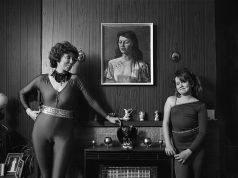
In addition to this early work being set here, over the years Amber had also been linked to and conducted a number of pieces of work in North Shields. For example as early as 1979 Nick Hedges was commissioned to document the fishing industry for Amber’s Side gallery, while Jungle Portraits was a series of photographs taken in an infamous public house in North Shields in 1979-1980. The area was also one of the locations for the Amber film Tyne Lives (1980) and for the collective’s filming of Tom Hadaways’ drama The Filleting Machine (1981) concerned with the consequences of fishing technology (which incidentally was filmed on ‘The Ridges’ which later become the Meadow Well estate where Dream On was set). Finally, one of Amber’s founding members, Sirkka-Liisa Konttinen, had taken photos at a dance school in North Shields as early as the 1970s as part of Amber’s The River Project (1974), with Amber producing a film on the subject Keeping Time (1983), an exhibition (1985) and a photography book (1989), both entitled Step by Step. So a considerable body of work and links with the area had already been built up over the years.
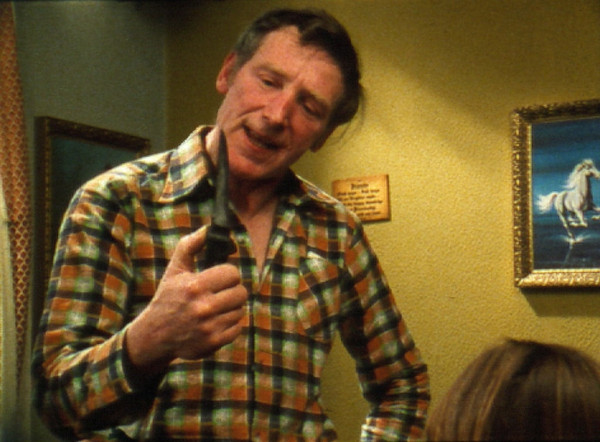
Amber also had personal and political links with North Shields. For example, Amber’s association with the writer Tom Hadaway extended back into the mid 70s when they introduced him to Live Theatre. In addition to filming his play The Filleting Machine, Tom was also the writer on the Amber film Seacoal (1985). However, the link here was not just professional but personal – Murray Martin once stepped in and ran Tom’s North Shields fish business for a period when he was recovering from an illness. Additionally, a number of members from the collective had already moved to the coast, or had lived there previously. One of Amber’s new partners who joined at the beginning of the residency, Pat McCarthy, had also lived and worked in North Shields for a good number of years. As she explained: ‘North Shields, the way we did that, I mean, I had quite a lot of knowledge of North Shields because I’d worked there and lived there. Murray had worked around the Fish Quay and there was Tom Hadaway who had a fish shop in North Shields, so there were all sorts of different connections you had there’. (Amber Heritage Project Interviews, 2004).
Political links had also been forged with the local council and particularly with trade unions in the area. As Conservative government reforms in the health service and the local authority began to take shape and affect councils such as North Tyneside, Amber’s Current Affairs Unit responded as one Amber partner explained: ‘…there was a base in North Shields, and also strong links in what was happening politically in Shields and in the arts in North Shields as well. I think it was quite natural to start looking first of all at what was happening politically, and one of the big things that was happening then was privatisation, it was the big move to Thatcher privatising all the local authority and that was of interest to us all. And that was an area that we started making videos on. I think we made 5 or 6 videos under the current affairs’ (Amber partner 5).
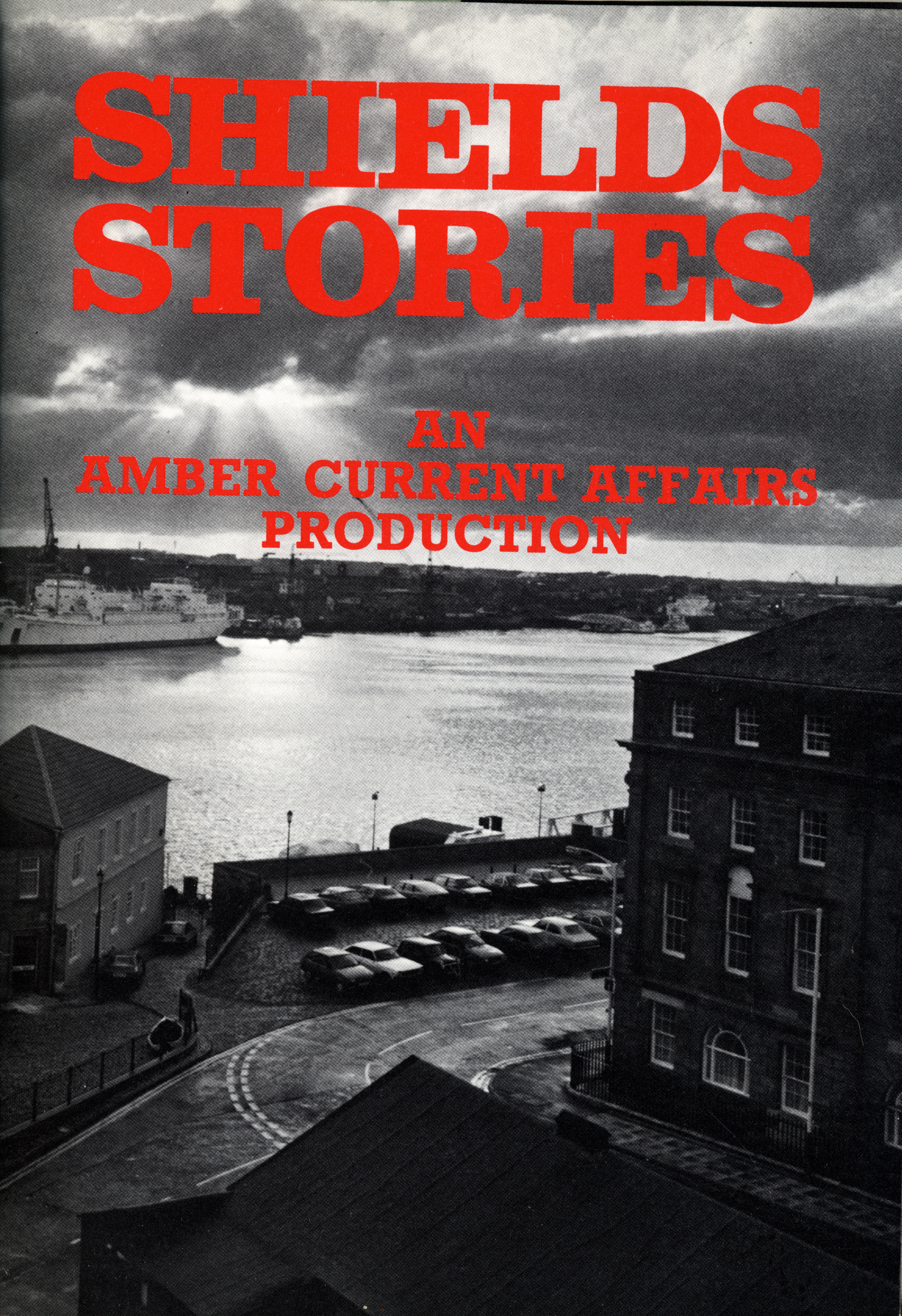
Similarly, Amber’s The Privatisation Tapes (1986) looked at the prospects for local authority and hospital workers whose jobs were under threat, and was used by trade unions in the area, being seen by over 11,000 people. Some of this material on privatisation also found its way into one of the episodes of Shields Stories (1988), Amber’s short lived alternative soap inspired experiment.
Finally, one of the fundamental criteria for selection by Amber however was that the move needed to be to an identifiable working class community. As one partner of the collective explained: ‘And then obviously the whole attraction of the fishing industry, the shipbuilding, the industries that were there, the river, the visual location, you know, it kind of all added up really’ (Amber partner 1). As well as the ‘visual quality’ of the area, even more important was North Shields’ industrial character and its people. As Martin explained: ‘It also had real access, I mean, working class communities, Byker had been the same but North Shields was the other area which people connected with you, they spoke to you in the street and you knew that that was where life was lived’. (Amber Heritage Project Interviews, 2004).
To find out what happened next, look out for Parts II and III, coming soon, where we will examine some of the activities Amber engaged in to insert themselves into the community and look at what impact the move had for group dynamics and work commitments, and finally focusing on two of their best-known films produced during this period: In Fading Light (1989) and Dream On (1991).
Robert Hollands is an Emeritus Professor of Sociology in the School of Geography, Politics and Sociology, Newcastle University. His interest in North Shields stems from his academic interests in urban studies and the sociology of the arts. His connection and affection for the area comes from his wife Carole Wears, who was born in North Shields and stories from his father-in-law, Peter Wears, who was a postman on the Fish Quay for a good number of years.
Read more published research on Amber by Richard Hollands and John Vail:
Hollands R. and Vail J. (2015) Place Imprinting and the arts: A case of the Amber Collective: https://journals.sagepub.com/doi/full/10.1177/0269094215573170
Vail J., and Hollands R. (2013) Creative Democracy and the Arts: the participatory democracy of the Amber Collective: https://journals.sagepub.com/doi/10.1177/1749975513480958
Find out more about the Amber Film & Photography Collective: www.sidegallery.co.uk