
In an age dominated by digital noise and social media polarisation, a quiet but powerful initiative is bubbling up in North Shields, reminding us that genuine culture resides not only on gallery walls but in the shared stories of everyday people. Spearheaded by Anne Morrell and hosted by Mark at The Engine Room on Tanners Bank, this new quarterly event – dubbed “Talk In Terns” – aims to bring local residents from all walks of life together in an intimate, seated setting to simply share their stories. The idea is to establish a platform for genuine human connection, enriching the cultural story of North Shields by celebrating the lives that make up our community.
The inaugural event on 24 March was very well received, setting the tone for the initiative. Host Mark began by thanking the audience, emphasising their vital role, and stating that without them, the venue would merely be an empty room.
The event’s creator, Anne Morrell, then explained the concept’s origin, which stemmed from her daily walk along the waterfront. She described observing the ‘pulsating human life’ which was all around her and how in her conversations with the people she met she had experienced the deep human connections that transcend differences in age and background, and weave the fabric of community and belonging.
Next, Mark introduced Susan Olney, a venue supporter whose experience at previous spoken word nights inspired her to write and perform her own poetry. A local resident with a background in town planning, Susan shared ‘A Place of Joy,’ a poem about The Engine Room’s location, which included a reference to the area’s history of leather tanning. She also performed ‘800 Years’, which chronicled local history from the time of the monks and a fisherman named Geordie Phil.
Finally, guest speaker Trudi Thompson, author of Men from the North, talked about her decade-long research into the history of North Shields FC, which was initially sparked by a local newspaper article. Trudi emphasized the club’s deep community loyalty, highlighting the nearly 50,000 people who celebrated their 1969 Amateur Cup win at Wembley. She framed her book as an important social documentary by discussing historical struggles and sharing the story of the club’s first president, Charles William Taylor.
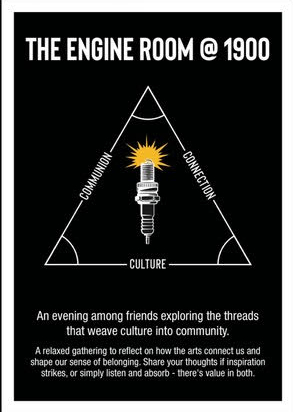
Anne’s concept is a deliberate antidote to the notion that culture must be ‘introduced to people’ through beautiful artworks, sculptures, or formal music. While such expressions are needed and valuable, she argues they risk feeling imposed if they don’t relate to how people see themselves and their place within the community. Living culture, she suggests, is being created every day in the stories of our lives, informed by the folklore and tradition of the past and enriched in our experiences of the present. By giving the platform back to the community, it is hoped that ‘Talk In Terns’ will instill a crucial sense of ownership over the town’s cultural narrative.
The event’s format is straightforward: an invited local person sits with the host for a relaxed and informal conversation. It is explicitly “not about a presentation” but an encouragement to share. The aim is to create an accepting, safe place where participants feel confident enough to talk about “who they are and the life they have lived”. The audience, limited in size to ensure intimacy, commits to absorbing and listening without judgment. This exchange is designed to be deeply transformative, not just for the speaker – who gains confidence and finds change for the better in being heard – but for the listeners, who gain a deeper appreciation and understanding of the differences and commonalities among their neighbours. Anne envisions a range of speakers covering a multitude of topics, from artists and musicians to fishermen and historians – in fact, anyone with a story to tell.
This focus on shared humanity is the core value driving the initiative. It’s a mechanism for weaving webs of community that counter the polarisation and rapid judgment often magnified by social media. Anne perfectly encapsulates this philosophy, stating: “It’s about recognising our shared humanity and anything that opens our eyes and helps people to understand each other is transformative.”
The Engine Room is committed to cultivating a dynamic, welcoming, and people-driven culture, which it achieves through the sharing of personal narratives. To maintain this, the venue plans to host events quarterly, with the next ‘Talk In Terns’ scheduled for Tuesday, June 16th at 7pm. Visit the website to find out more: