Most people are aware that the former Cosalt factory on the Fish Quay has now been transformed into an entertainment venue, housing the Salt Market Social and the Loading Bay below. Some may not know that in addition to this, inside the tall part of the iconic blue building there is very important work going on every day. The Marine Management Organisation occupies two floors and it is the base for teams including Marine Enforcement and Marine Licensing. To find out more about what goes on there, I caught up with Fern Skeldon, Senior Case Manager for Policy Support.
Fresh from attending the annual conference of the Shellfish Association of Great Britain, held at the appropriately named Fishmonger’s Hall in London, Fern was keen to point out that such black-tie events are not a typical part of her job. She had given a talk on ‘coastal squeeze’, the reduction or deterioration of natural coastal habitats due to human activities. Fern’s everyday work as part of the Marine Licensing team involves managing the delicate balance between these two aspects, striving to preserve nature whilst enabling development along our beautiful coast.
An arm’s-length body of Defra (Department for Environment, Food & Rural Affairs), the Marine Management Organisation looks after all the seas in England, regulating everything from the fishing effort to building wind farms and removing litter from the beaches. “The Marine Licensing team are the planners of the seas”, Fern explains. “If someone wants to build something on or near the water, they apply to us. We work with the port sector, offshore wind, seaweed and shellfish farms, marinas, harbours and even individual applicants. For example, someone may own a property on a river and want to build a jetty. They need a licence for that.” The MMO issues building licences in the sea and the foreshore, which is determined by the highest astronomical tide. “My main role is to see how we can make it more efficient for applicants to get licences by working directly with Defra on policy development.”
It was 16 years ago that Fern moved from her job at HMRC to what was then the Marine and Fisheries Agency, when their headquarters moved from London to Newcastle. “There was a lot of training on the job. There is always ongoing training. My first licensing application was for the Port of Tyne on their maintenance dredging licence. I’ve worked closely with them ever since.” The Port of Tyne actually has an office on the top floor of the Salt Market building. On the floors below, as well as Marine Licensing, there is also the Marine Enforcement team. “They carry out regular inspections, for example to make sure the right sized fishing nets are used.” Conservation and preservation of the environment is integral to the work of the MMO. Fern recently visited the Sofia offshore wind farm on Dogger Bank, the shallow central area of the North Sea: “Offshore wind is huge. There are five different developers working together and Dogger Bank will be the world’s largest offshore wind farm.”
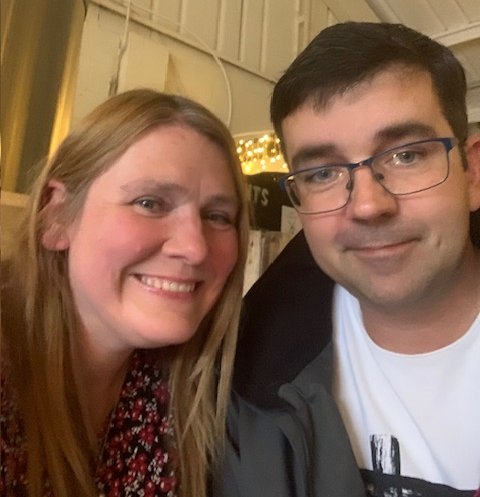
Fern has to assess the impact that everything has on the environment. “The main focus is making sure that protected species aren’t harmed. For example, there are conditions about working on the Tyne Bridge during the kittiwake nesting season. Our remit goes right up to the tidal reach of the river. When I got the job, people joked that I’d be counting fish. The reality is that there are a lot of birds!” Fern has also helped to rescue several birds in her own time who have found themselves in trouble. “People don’t realise that herring gulls are on the red list too. We see a lot of them because we live on the coast but their population is depleting.” She and her husband, Stuart, care deeply about animals and share their home with three rescue cats: “One is a feral and two are what we call our ‘walk-ins’ – they just turned up and stayed!”
Fern also cares about people, and alongside her job she finds the time to be the Group Vice President of the Public and Commercial Services Union. Representing the whole of Defra, she provides support for around 800 staff from various departments including the Rural Payments Agency, Natural England, the Forestry Commission and Food and Farming. They cover members working across the UK with branches supporting members on a regional level. The Northern region covers Yorkshire, the North East and the Eastern side of Scotland, with the highest cluster of membership based at the Defra offices in Newcastle.
Fern feels lucky to live and work in North Shields: “It has always been home. I was born in Preston Hospital, went to Christ Church Primary School and Ralph Gardener High School. We had our wedding at Christ Church. I wouldn’t live anywhere else. There is a real buzz about the place now and I love seeing the town’s transformation, with all the effort people are putting in to make it a nice place to live.” Fern and Stuart can often be found in one of the several Shields pubs that serve quality craft beer. They both joined the ‘Mariners and Marras’ folk group after watching them rehearse at the Enigma Tap, and they have enjoyed performing all over this year as part of the North Shields 800 celebrations. If you ever happen to hear them singing their songs of the sea or find yourself enjoying a stroll along the Fish Quay, spare a thought for all the hard work that goes on behind the scenes to ensure the preservation of our precious oceans for future generations to come.