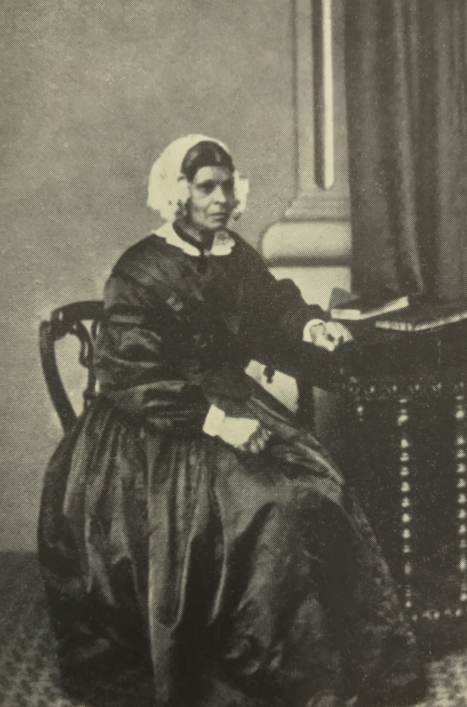
Mary Ann Macham was an enslaved woman who escaped from a plantation in Virginia, USA, and endured a treacherous sea journey, eventually arriving in North Shields on Christmas Day 1831, marking the start of 60 years of freedom in the town.
She was met by members of the Spence family, prominent Quakers and businesspeople, also supporters of the abolition movement. They befriended her, providing work and a home.
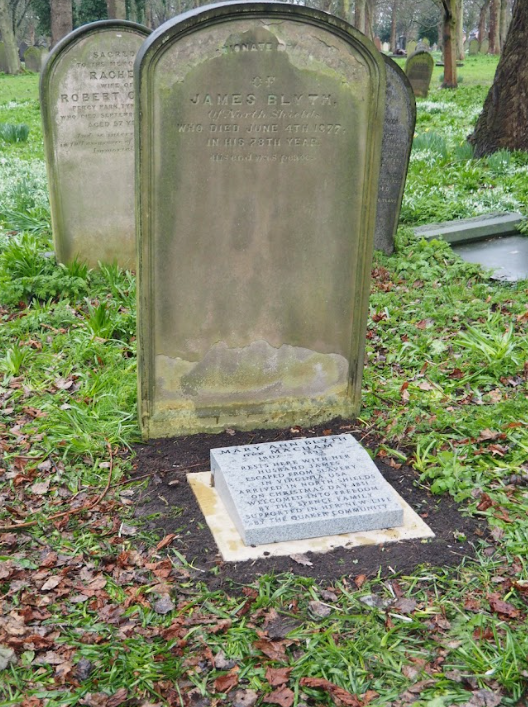
She later married a local man, James Blyth, a Spence employee. On arrival in Shields she stayed first in a lodging house in Tynemouth, before moving to Dockwray Square and later Howard Street, near to the site of her statue. When she died in 1893, she was staying with her late husband’s family in Benwell. She is buried in Preston Cemetery, next to her husband.
In 1950, her story – as told to a member of the Spence family – was included in the parish magazine of Christ Church.
This tells how she was born in Middlesex County on 10th May 1802, the daughter of a farm owner’s son and a black enslaved woman. Such a birth was considered a ‘great disgrace’ and at 15 months, she was taken from her mother and sent to her father’s sister who cared well for her until she died. The aunt’s daughter then married a man who was in debt and when he could not pay his rent, a sheriff arrived, taking Mary Ann to his farm for three months, where she was treated very badly.
Aged 12 she was ‘put up for public auction’ and bought by a ‘gentleman’ at the market. She said: “I was a poor puny little thing, but he bought me for 450 dollars.” At his farm, where there were about 200 other slaves, she was treated kindly but after a while, ‘they became cruel, especially the mistress’, who used to send them to the barn to be ‘thrashed’. Slaves were ‘whipped with cowhides’ and she had marks on her body that she would carry to her grave.
She didn’t see her mother until she was about 20. Once, she attended chapel near where her mother lived and the mistress’s sister said there was a woman in the chapel who must be her mother as they were so alike ‘except that one was black and the other white’.
She stayed with this master and mistress for about 17 years. Punishments included being locked up for several days at a time, once for helping another slave to pick up a dropped stitch while knitting.
She eventually took the brave decision to escape, helped by a friend, who was enslaved to the harbourmaster.
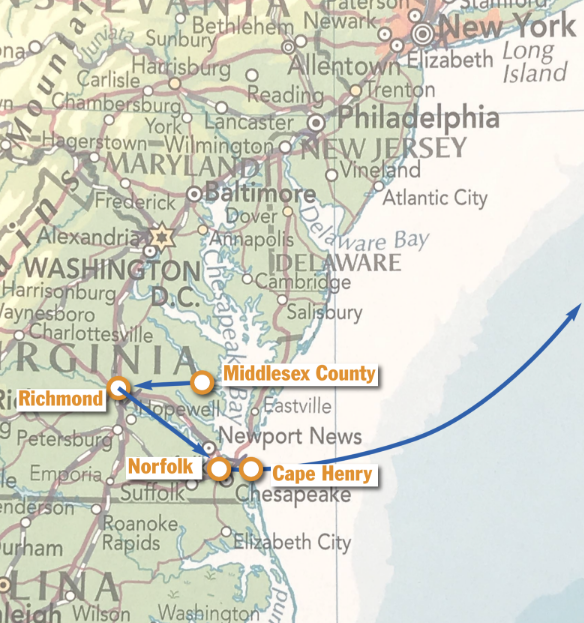
The friend hid her under a tree, providing bread and water. ‘There was a great outcry’ when she was not found and men on horseback with bloodhounds dashed through the woods where she was hiding.
To avoid capture she moved from place to place, sometimes surviving on fruit growing on bushes. She slept in the trees because of snakes, tying her frock tight around her and covering her head and neck with her shawl to keep them away from her. When the weather became very wet, she hid her in a hayloft and then in a haystack.
It was six weeks before an expected ship from England arrived on the river. Her friend knew the ship’s mate, who agreed to take Mary Ann. She was taken to the ship on her friend’s husband’s boat, hidden under a pile of wood. The mate hid her in the damp hold among water casks. Mary Ann said she heard the captain read out a notice offering a reward for her capture.
After ten days the ship set sail for the Netherlands which took 60 days, some of the time in rough weather, hidden in cramped mosquito-ridden spaces. When the weather was bad, they thought they would never reach the port. They stayed at Flushing about seven weeks, before setting off for Grimsby.
Of the journey, she said: “After being in the woods all that time it was dreadful. I had very little to eat, sometimes half a biscuit would last me a couple of days.”
Finally, the journey to Grimsby took about 48 hours and after two days they went to Hull and then to York, from where she ‘coached all the way’ to Shields on a bitter cold night, arriving on Christmas morning, to be met by ‘two Miss Spences, of the Friendly Society’.
After ten days she got a place in a lodging house in Tynemouth. From there she spent two and a half years working for a Mr Jordison in Dockwray Square and then went to work for Mrs Spence in Howard Street, where she stayed seven years and was married from there.
She said of the Spence family: “That family has always been kind to me and has never lost sight of me.”
Her story was highlighted in an exhibition in 2019, ‘Breaking Chains’, at the Old Low Light Heritage Centre, North Shields Fish Quay, which explored the role of townspeople in anti-slavery campaigns.
This was after a local woman, Steph Towns, brought information about Mary Ann to the centre. Trustee and volunteer Nina Brown then coordinated a group to research and curate the exhibition, which later won the prestigious North East regional Marsh Award for Volunteers in Museum Learning 2019, which is run by the British Museum and the Marsh Christian Trust.
Some of the exhibition boards are currently on display at the Old Low Light and a short video about the exhibition is available at https://oldlowlight.co.uk/digital-heritage/
Extract from ‘The Street of Aa’l Nations’
by David Young
Look, here shi’ stands the stooped aad woman with the deedweight of stinking fish dripping from the whicker creel strapped to a back, she watches aa’l the gannins on doon here like she has done for ivvor, her cut and disfigured face a testament to the superstitions that grip the maritime industries. Sailors, whalers and fishermen would cut a piece from a’ face or a’ hidden modesty to bring good luck. They caaled a’ the ‘Wooden Dolly’. I’m sure shi’ smiles when they’re not watching and remembers how it used ti’ be.
The furst fower ‘Dollies’ were fastened tight to Customs House Quay suroonded by sail lofts, rope works and block makers. They aa’l bore witness to the wickedness o’ the press gang, stealing men away from tha’ family between ebb and flood. Carried off to Peggy’s Hole and forced to surve before the mast till stitched through the nose and launched in canvas shrouds upon some foreign watter.
So many memories they torn and dart within the Dolly’s aad oak heed like shoals of sprat in choreographed forage. Then one will liberate itsell and be caught in the aureole. She sees and hears it clear. Mary Ann Macham.
… ‘What brings you to Shields?’, he asks.
She hesitates, considering her answer. ‘I am a larcenist.’
‘A common trade around here, although few would own up to such a career. What is it you steal?’
‘Lately this woman’s body which I took away from its rightful owners back in Virginia.’
‘Are you telling me that you were delivered here away from a life of bondage?’
‘That I was. I, my mother, and her mother were all owned by the same family. My forebears were caught in nets much like your herring and sold at auction just the same. But at least for the fish their suffering ends with the fillet knife. For the slave there is no end, the torment follows you from your first breath till finally they lay you out on the coolin’ board.’
‘But how did you escape such a life and end up here in Shields?’
‘I travelled here along a path of whispers. Passed from one good soul to the other, guided by God and the drinkin’ gourd. All the time waiting for the pattyrollers to seize me and take my liberty from me. But let me tell you this, they wouldn’t have succeeded for I would have ended my life in the water or from a dogwood rather than submit again to the whip and the rubbings’…
I, Low Toon welcomed them aal. Nee copper effigy here with hypocrisy scrawled across its base, Rainbird’s ’Street of Aa’l Nations’. A place of many languages and particular nationalities associated with specific streets. Jarmins and Norwegians in Bell Street, Greeks and Spaniards in Clive Street, and Lascars at the Bull Ring. Interspersed throughout this ever-changing community another twenty or thurty countries represented in numbers ranging from ones and twos to larger collectives. All borne ova the watter in ships of timber or steel, driven by wind or driven by science.
Me fatha would tell is ‘Thi ownly nationality you wouldn’t find on Low Toon was an Eskimo.’
‘Why’s that?’ I would ask.’
‘Because it’s just too cowld for thim,’ he would say.