Distance: 2.5 miles
Start and finish: Segedunum Roman Fort
Uncover the ancient and varied past of Wallsend from the Sedgedunum Roman fort at the eastern end of Hadrian’s Wall to its famous ship building and coal mining heritage.
Start: Segedunum Roman Fort
The walk starts where the 84 mile (135 km) Hadrian’s Wall Path comes to an abrupt end on the north bank of the mighty River Tyne, at the Roman fort of Segedunum.
Meaning ‘strong fort’, Segedunum was the first, or last, of 17 forts along the length of the wall and it was home to a sizeable cavalry barracks. A large area of the fort has been exposed and shares the site with an award winning museum and interpretation centre.
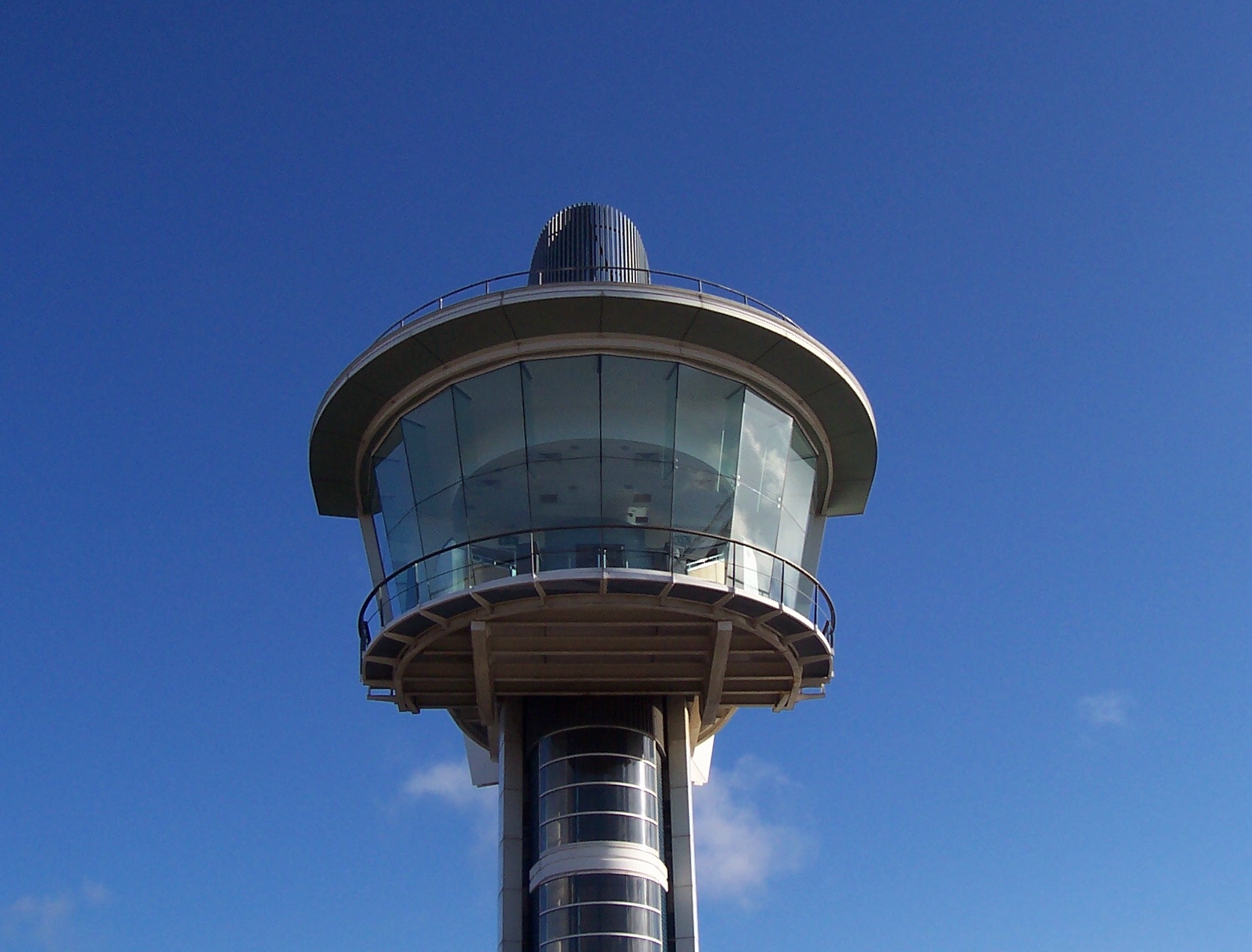
The 35 metre high space age viewing tower is a landmark in itself. With the tower on your right, head the short distance to the first junction and the four faced cast iron clock.
This ornate, Gothic-style clock dates from the late nineteenth century and enjoys Grade II listed status.
Swan Hunter’s
To your right, down the steep slope, is one of the region’s most famous industrial views, the entrance to the world famous Swan Hunter’s shipyard.
Many times in the past have we seen television footage of an army of workmen rushing up the hill at the end of a day’s shift.
Shipyards and ships
Shipbuilding dominated Wallsend riverside for more than 100 years and gave the town its worldwide reputation.
Literally hundreds of ships were built over the years by Swan Hunter, Wigham Richardson, North Eastern Marine and Wallsend Slipway, with many of these ships bringing pride not only to the town but to the whole nation.
The Mauretania
In 1906 the ocean liner, The Mauretania was launched on the river and carried 2,000 passengers on its maiden voyage. It captured the Blue Ribband for the fastest crossing of the Atlantic, a record it held for 22 years.
Esso Northumbria
In 1969, the 253,000 ton tanker Esso Northumbria, left the slipway to huge celebrations. It was the largest merchant ship ever built in the U.K.
HMS Ark Royal and Illustrious
The aircraft carrier, HMS Ark Royal was launched from Swan Hunter’s on 20 June 1981 by the Queen Mother and was the fifth ship of the Royal Navy to bear the name of the flagship of the English fleet which repelled the Spanish Armada.
Its smaller sister, HMS Illustrious was also built at Wallsend.
Historic shop shutters
Turn left into Station Road.
As you approach Wallsend Metro Station, at the end of the short terrace, stands a corner shop currently occupied by a barber. If the shop shutters are down you will notice that these contain an image of a wave of shipyard workers making their way up Station Road past this very corner at the end of a day’s work.
These two historic shop shutters are part of a project to brighten up Wallsend town centre, and to spark fresh interest in local heritage.
There are a total of 18 shutters decorated with images from Wallsend’s rich history with scenes ranging from ship launches and trams to workers leaving Swan Hunter’s shipyard, a former cinema on Station Road, and the narrow streets of old Wallsend.
Metro Station Latin installations
Once at the Metro Station it is worth climbing the stairs to either platform to peep at the scant remains of the bi-lingual signage and other Latin language installations that once adorned the platforms.
Created by artist Michael Pinsky, as part of a wider project, the signage was an example of the town’s highly visible Roman roots.
It is a great pity that these were not left in situ when the station was revamped.
St. Luke’s Church
Pass under the railway bridge and within less than 200 metres you reach the Church of St. Luke. Designed by Oliver and Leeson, who were also responsible for designing Cullercoats Lifeboat Station, this 1886 church was described by Nikolaus Pevsner in his authoritative 1957 book, The Buildings of England: Northumberland as being ‘a big serious early English church’.
The highlight of the interior of the church is the 1922 stained glass First World War memorial window by the Irish artist Wilhelmina Geddes, a window described as, ‘the best north of the Alps’ and also, by Nikolaus Pevsner, as of, ‘quite exceptionally high quality’.
It is considered to be her finest work.
Memorial Hall
Turn left into Frank Street, quickly reaching the Memorial Hall, erected in ‘memory of members of the staff and workmen of Swan Hunter and Wigham Richardson Ltd. who fell in the Great War 1914-18’.
The war memorial, by sculptor Roger Hedley, set into the side of the building, was unveiled on 15 August 1925 and contains, to either side, bronze life size figures of a seaman and a gunner, with rifles reversed.
Turn right into Atkinson Street and then right again into High Street.
The Anson pub
Cross over immediately, heading to your right in the direction of the Anson public house. Named after the battleship HMS Anson, launched in 1942 from Swan Hunter’s shipyard, the Anson public house was opened in early 1967.
Market Woman
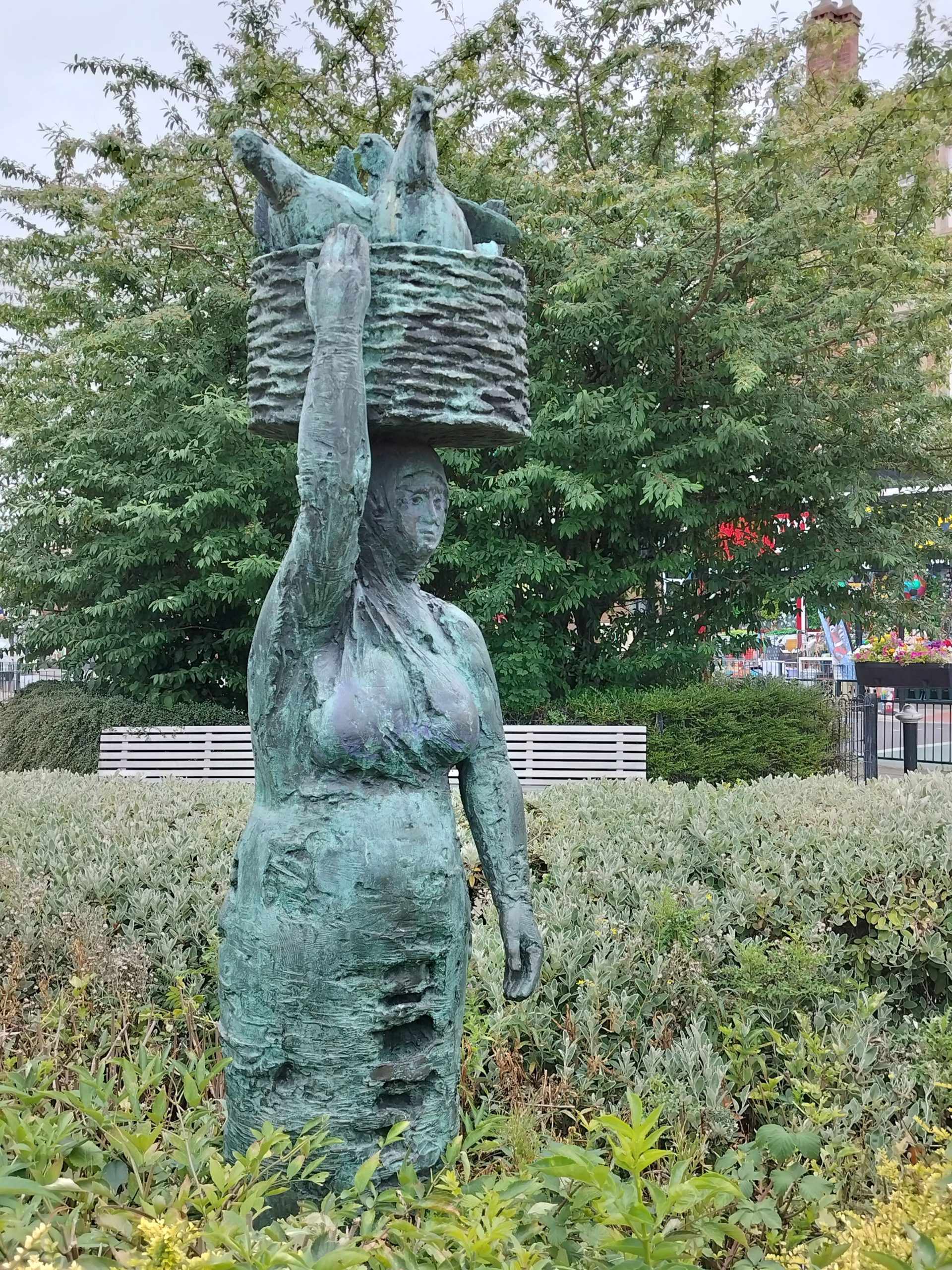
On your way, you will meet, the eye-catching Market Woman by artist and sculptor Hans Schwartz. Born in Vienna in 1922, Schwartz was orphaned as a teenager when his father died in Auschwitz concentration camp.
Eventually settling in England, he became a full time artist in 1964 and was commissioned by the National Portrait Gallery to paint the portraits of Nikolaus Pevsner, Joe Gormley and Tom Jackson.
The Market Woman was installed in 1966 and Hans Schwartz wanted her to ‘appear as a tough hardworking peasant and not a graceful girl’.
At the time of unveiling the work was greeted by a storm of criticism.
These days the bronze work is much better loved and deservedly so. The work inspired the poem, Do They See You Standing There which begins with the lines:
Do they see you standing there
In that busy forum
Trading your quartet of squabbling hens
A bare-footed peasant
Trapped in an alien world
Do they know whose nimble hands
Cupped those ample breasts
Gave shape and form
Those fingers moulded
Those strong broad hips
Forum Shopping Centre
You are now standing on the edge of the 1965 built Forum Shopping Centre, the name being another reminder of Wallsend’s Roman lineage.
Continue to the right of the Anson public house, rejoining Station Road as it heads away from the main part of the town.
After you have passed, on your left hand side, the Trinity Methodist Church cross over and on reaching the cross roads turn right into North Road.
Buddle School
On the opposite corner stands the former Buddle School. Built in 1876 for the Wallsend Schools Board, this Grade II Listed building, built in the Scottish baronial style, was once home to the Buddle Arts Centre.
Unfortunately, the building is currently unloved and boarded up.
Richardson Dees Park
Just after the former school, in North Road, is the entrance to Richardson Dees Park. if time allows, spare a few minutes to wander along its pathways.
The park was developed around a piece of land, formerly part of Wallsend Colliery, and was presented to the town by Newcastle solicitor Robert Richardson Dees who lived in Wallsend Hall.
It is worth seeking out the renovated bandstand.
Allen Memorial Methodist Church
Be sure to leave the park by the same gate as you entered, turning left towards the red brick and sandstone trimmed Allen Memorial Methodist Church, named after John Allen a well known local chemical manufacturer. Notice the stunted tower, the original spire having being removed when it became unsafe.
Wallsend Green Conservation Area
As you head straight on, you are now entering the Wallsend Green Conservation Area and the original village of Wallsend.
Made up for many years by only a handful of farmhouses built around a green, this area became popular in the mid-nineteenth century with Newcastle merchants who had their large country houses built here.
Spend time to have a thorough mooch around, keeping your eyes peeled for the somewhat camouflaged concrete air raid shelter to the rear of 5 Park Villas on the corner of North Road and the historic fire hydrant set back from the houses on the grassed village green.
This peaceful area was one of only two village greens in the whole of Tyne and Wear that were deemed worthy of a mention in Brian Bailey’s 1985 book, The English Village Green. He suggested that it had been retained, ‘in the face of all probabilities, though it had to fight to do so in the nineteenth century when the green was threatened with development’.
Lily Bank Cottage
After admiring the fine Elm Terrace, particularly number 4, a late-Georgian survivor of the old North Farm, be sure to wander down Lily Bank as far as the first 90 degree corner, passing on your right, both the Grade II listed early nineteenth century Lily Bank Cottage and the Victorian post box set into the boundary wall of Wallsend Hall.
Head back to the top of Lily Bank and the junction with North Road.
Wallsend Hall
As you continue your journey by turning left you will be standing next to a small brick-built cottage and the entrance to Wallsend Hall. The buildings and grounds of this early nineteenth century-built, Grade II listed building were presented to the town by Sir G.B Hunter and were opened to the public in 1916.
The Hall became a hospital in the 1920s and in the 1950s an extension was built to create the Civic Hall.
The hall is currently boarded up and whilst you are free to wander into the grounds of the hall, which in essence form part of Wallsend Dene, you must do this via the entrance to the 1940 Art Deco-influenced Health Centre, the next building ahead.
Built at a cost of £22,000 as part of a government scheme to provide model facilities for mothers and young children, this building was affectionately nicknamed the Sunray Clinic because of the treatment used for the prevention of rickets.
It is a stylish and perfectly proportioned building.
Jasmine House and Cross House
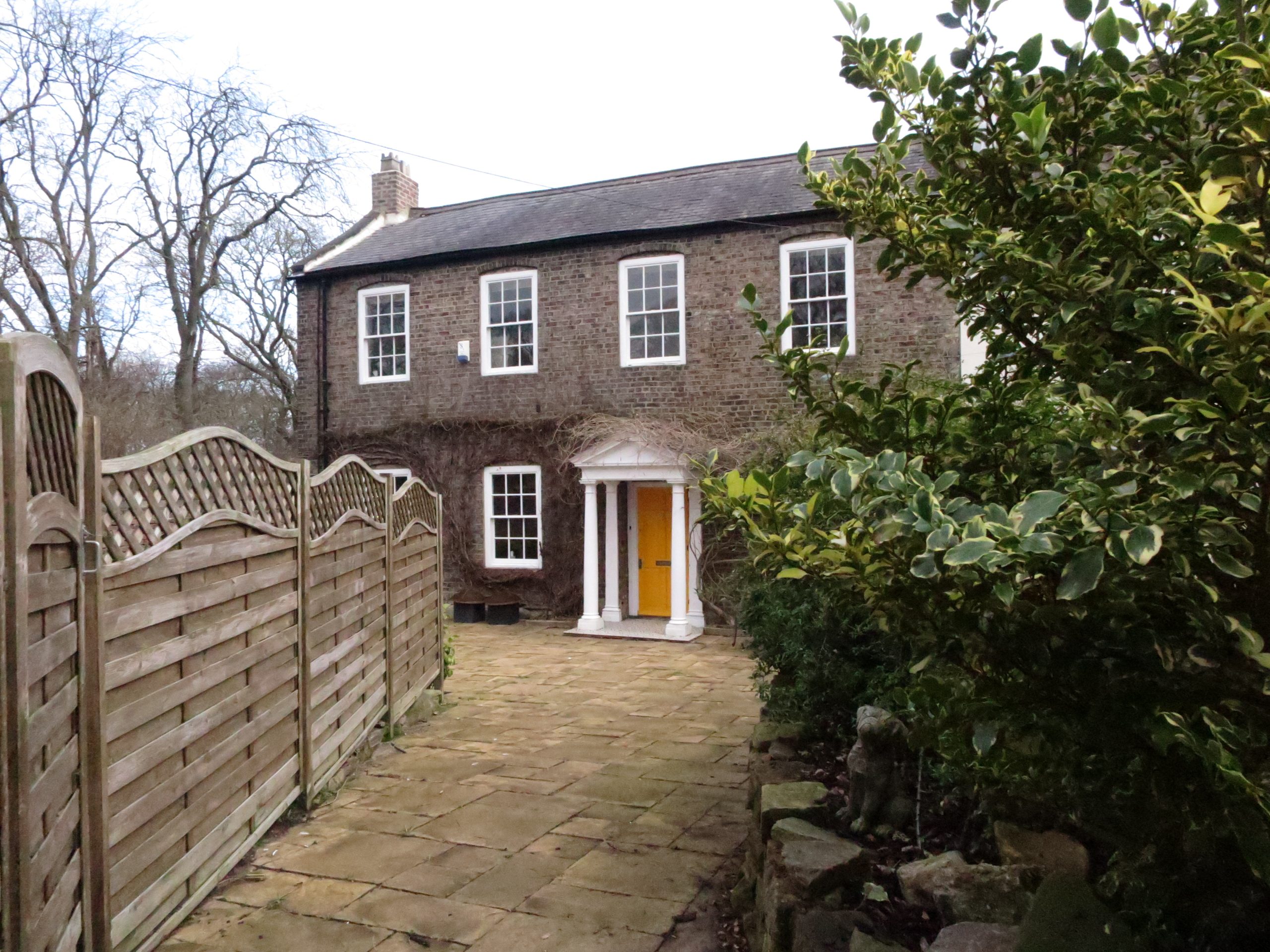
On the corner, where Crow Bank falls away steeply to Wallsend Dene, stand the Grade II listed Jasmine House and Cross House.
The two-storey Cross House was the former village school, gifted to the village in 1748 by a certain Isabel Stewart.
The building was temporarily used as a church between 1804 and 1809 and during that time the renowned Willington Quay-born engineer Robert Stephenson was baptised here.
It reverted to use as a private dwelling in 1835.The picture postcard mid/late eighteenth century-built Jasmine House was the residence of the schoolmaster.
Continue on past these two houses on a gently bending slightly downhill road which, after passing a renovated cottage on your left, rises into Boyd Road.
Continue, past Burnside Community High School on your left, until you reach the junction with High Street East.
Turn left and as you proceed forwards St. Peter’s Church will soon come into view.
Former New Winning Tavern
On your left is the 1894 brick and stone built former New Winning Tavern which was lovingly converted into flats and apartments in 2019.
The name of the former public house was a nod to Wallsend’s coal mining past and who can forget the terrible events. On the afternoon of 18 June 1835, an underground explosion killed 102 men and boys at Wallsend Colliery.
Millennium Seat
Now cross over the road and enter the churchyard of St. Peter’s Church.
Immediately to your right is the Millennium Seat, presented to the town by the Wallsend Pensioners and the Victor Mann Trust.
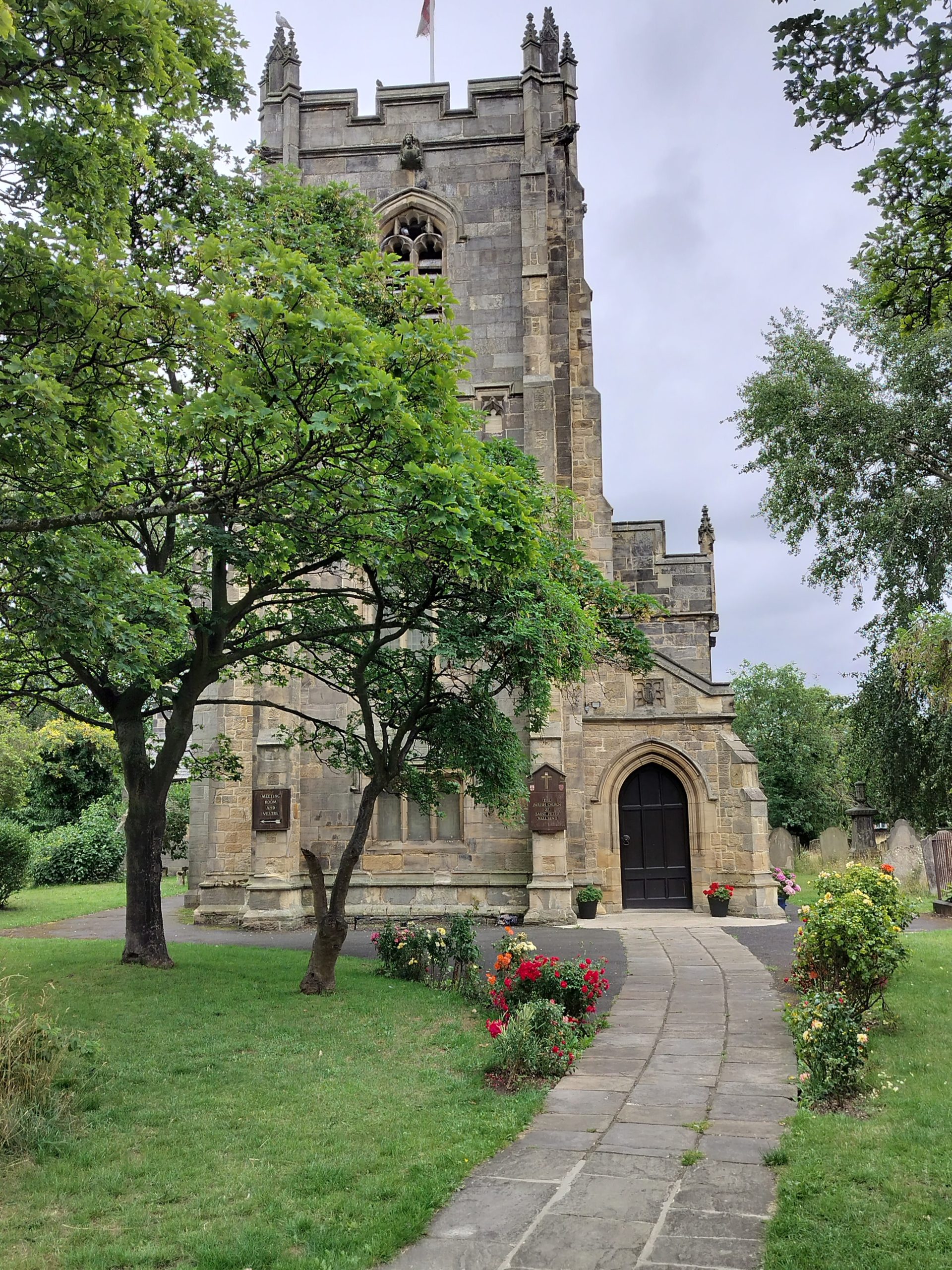
St. Peter’s Church
The church of St. Peter’s, which was consecrated in 1809, was built to replace the twelfth century Holy Cross Church, half a mile away to the north-west.
Subsequently it was extensively rebuilt in 1892 when it was, according to the 1992 edition of Nikolaus Pevsner’s book, ‘The Buildings of England Northumberland’, ‘enlarged and Gothicised in the Perpendicular style by W.S Hicks’.
In the churchyard there is a small plaque in memory of those who died in the 1835 colliery disaster.
Leave the churchyard and turn left back into High Street East, which you will now stay with for quite some time.
Richardson Dees Primary School
You are following the route of the old North Shields to Newcastle turnpike road. Soon you will pass, on your right, Richardson Dees Primary School.
Designed by Newcastle architect Benjamin Simpson, who was also responsible for the flamboyant and much-loved Emerson Chambers in Newcastle (currently home to a Waterstones bookshop), this handsome school was officially opened in 1902 and was subsequently refurbished in the 1980s.
‘Ghost’ advertising sign
To your left watch out for the now barely discernible ‘ghost’ advertising sign, painted above the ground floor of the house on the corner of Myrtle Grove, which proudly declares, ‘This is Whitfield’s The Bacon Specialist’. This is a lovely reminder of the time when this building housed one of the many corner shops which dotted these terraced streets.
Former Coach and Horses pub
As you proceed forwards the ornate Jacobean-style former Coach and Horses public house looms large.
Built in 1907, this Grade II Listed building has been empty for a number of years and in 2023 appeared on the Victorian Society’s Top Ten Endangered Buildings.
Former Town Hall
It stands alongside the imposing former Town Hall.
This Grade II Listed Baroque-style building was opened in 1908 and forms part of a larger block of buildings which consisted of a fire station, public baths and a police court.
When Queen Elizabeth II visited the area in 1954 on her coronation tour she stood on the building’s balcony to address members of the public gathered on the street below.
In 2015 the former Town Hall was refurbished and now provides modern office and conference facilities for a range of businesses.
Continue along High Street East, crossing over Station Road before passing once again the Forum Shopping Centre over to your right.
Former Ritz cinema
Before you turn left into Carville Road continue for about 100 metres along High Street West until you see, on the opposite side of the road, the former Ritz cinema, now a Wetherspoon’s public house.
This Art Deco-style building, which opened in May 1939, was designed by Newcastle architects Percy L. Browne, Son and Harding.
The cinema catered for 1,092 people in the stalls and 544 in the circle and the last film was shown on 8 of September 1962.
The building quickly reopened as a Mecca bingo hall which ultimately closed on 9 October 2011.
It was then converted into a public house by J.D Wetherspoon who retained much of the original cinema seating and features.
Now head back the way you came and turn right into Carville Road.
You are now only a short distance from the end of your journey.
Our Lady and St Columba Church
As you wander towards the river, note the 1957 brick built Catholic Church of Our Lady and St Columba tightly squeezed next to the Metro railway line.
Designed by Newcastle architect Vincente Stienlet in a style described as, ‘a fusion of Perpendicular Gothic freely interpreted in a modern idiom and infused with Scandinavian and Art Deco elements’, this church is Grade II listed.
As you pass under the low bridge, the riverside cranes which once dominated the view have long since disappeared, reminding us that the glory days of shipbuilding on the River Tyne have now been assigned to history.
When you reach Buddle Street, so named after John Buddle the Manager of Wallsend Colliery who was actively involved with Sir Humphrey Davy in the development of the safety lamp bearing his name, turn right.
Hadrian’s Wall
Here stands a reconstructed section of Hadrian’s Wall unveiled on 5 June 1997 and running alongside the foundations of the original wall.
Nearby, the scant remains of Wallsend Colliery’s B Pit can also be seen.
Finish: Segedunum
As you close the iron gate and step back into Buddle Street you have more or less come to the end of your walk of discovery at the place where Wallsend’s long history first began all those many years ago, at the fort of Segedunum.
If you happen to be heading home via the Metro network make sure, as you pass through the transport interchange on your way to the station, to keep a watchful eye for the pedestrian underpass which connects the two platforms.
This has recently been given a spruce up by Newcastle artist Mark One87 who specialises in mural and graffiti art. As you examine the colourful detail of the two murals you will see that they give more than a gentle nod to Wallsend’s rich history.
Devised, written & photographed by Geoff Holland 2006 (Revised 2025)
Edited for web by I Love North Shields. Previously published in its original form by North Tyneside Council.