
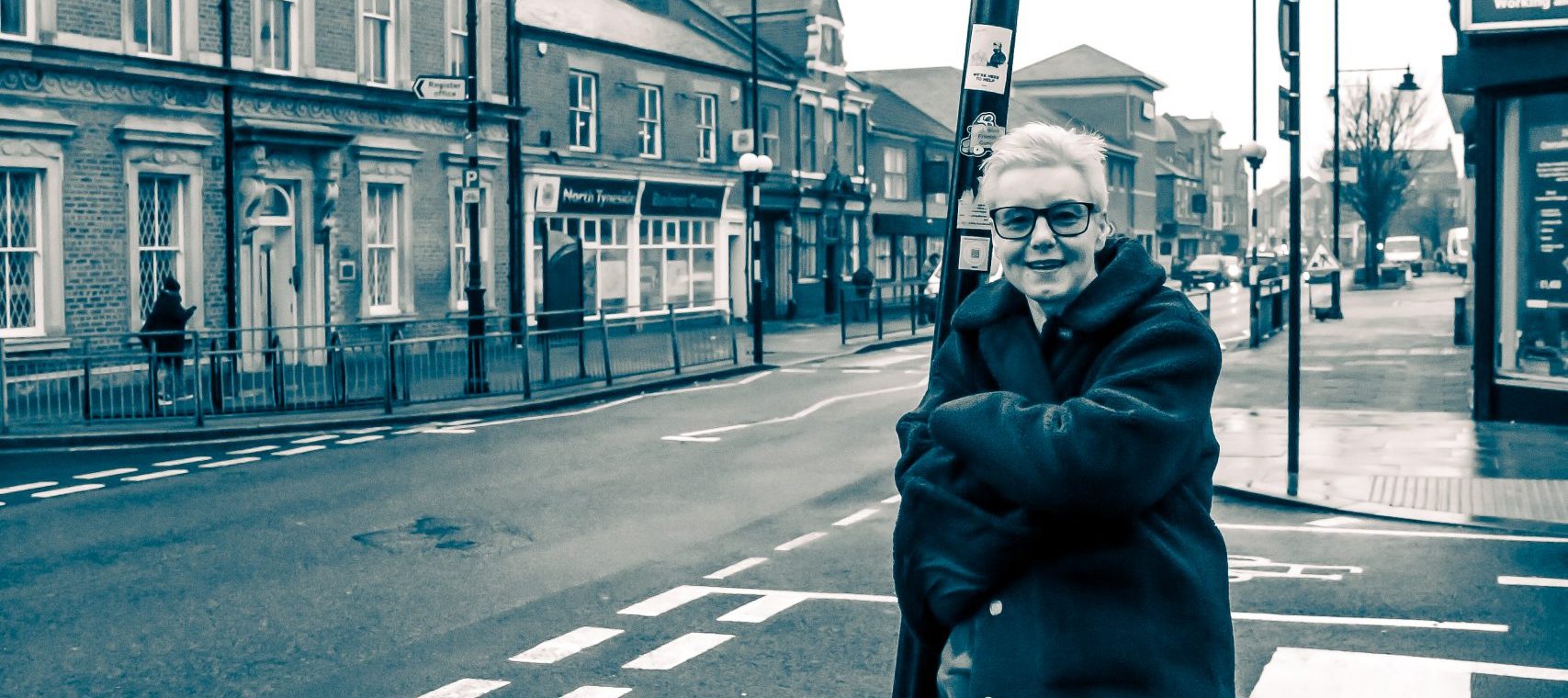
Listening back to my interview with musician and writer Julie Grant, a popular nineties song comes to mind; ‘Tubthumping’ by Chumbawamba, famous for its rousing refrain: ‘I get knocked down / But I get up again / You’re never gonna keep me down.’
The professional life of Julie Grant is less a career and more a sustained act of insurgency. From a fractured family start in North Shields, where she felt like an uninvited guest, to a high-speed emergence onto the national music scene, and later, infiltrating the ranks of television’s national institutions, Grant has consistently operated on her own terms. She is the epitome of the ‘gatecrasher’- a term that perfectly suits her upcoming memoir – entering elite, often London-centric, creative spaces without shedding her integrity or her regional roots.
Grant’s journey as the youngest of four was defined by a feeling of difference and an early, necessary rebellion. As she explains, her difficult relationship with her family, particularly an older brother, led to a profound sense of isolation. This feeling of being an outsider began at home, where she believes she ‘wasn’t accepted within the family… because I was different.’ This early experience crystallised into the central theme of her life and memoir: ‘It’s not a ‘pity me’ but I seem to have gatecrashed a lot of places where I ought not to have been.’
Her instinct for self-protection led to an early, unconventional choice. As a child, she shaved her head – not as a rebellion, but as a necessary defence mechanism to stop her brother from pulling her hair. ‘It wasn’t an attention seeking thing,’ she clarifies. The short hair caused her to be mistaken for a boy, a role she leaned into to join the local football team, further positioning her outside the conventional gaze of 1970s Britain. This need for independence and self-reliance became the backbone of her staunch independence, a quality that was tested in 1995.
At the peak of her early success, Grant turned down a coveted recording contract from Island Records. The major label wanted to turn her into a solo act and radically change her image. Her refusal was a non-negotiable act of loyalty to her band and her identity. Recalling the clash with the industry’s beauty standards, she states: ‘It’s directed at the music industry. Don’t you dare tell me or anybody else that you will not sell unless you look a particular way?’ She cites the label’s later signing of Sinead O’Connor, who had a shaved head, as a deeply ironic turn, highlighting the hypocrisy she was fighting against. This principled stand preserved her artistic soul at the expense of a likely shot at mainstream pop stardom, highlighting a steadfast loyalty to the collective that few artists of the era possessed. Her track ‘I Am Not Her,’ is her reflection of what happened.
Grant’s path into music was an evolution from solitary writing. Starting at an early age, she wrote her feelings down on scraps of paper and backs of cigarette packets as a way to unleash the tension and cope with having nobody to talk to within her family. Aged 14 she left home and moved into a squat in Jesmond and soon discovered a music collective based in Gateshead where she taught herself to play the drums on a set she could hire for a pound. The drums became a vehicle for her words, and she briefly became known as a ‘punk poet’ before deciding she wanted to write to music.
She formed the band Julie Grant, initially as a convenience because they couldn’t think of a name, but it was always about the collective. Within six months, they were on national television, but success brought the curse of internal turbulence. As the band took off, her bandmates, who had existing jobs, had second thoughts, scared to take the leap of faith required for full-time success. This felt like a betrayal and a repetition of her childhood experience: ‘I felt like I had gatecrashed their lives because the more it took off, the more they pulled back.’ Years later, she would run into the former guitarist, who told her walking away was ‘the biggest mistake of my life,’ an encounter that underscored the difficult, solitary path she took.
When her music career stalled, Grant pivoted into the structured world of television production, becoming a writer and technical producer for the BBC’s institution, EastEnders, a testament to her versatile narrative talent. This period of multi-disciplinary work provided the grounding that allowed her to navigate life with a diagnosis of Complex PTSD, which profoundly influences her work.
Never one to give up, or give in, Grant returned to her first love of writing music and, in 2020, her highly regarded record ‘Couldn’t Care Less’ was nominated for an Album Of The Year award. Her latest creative phase is marked by a return to writing and acoustic music, where her lyrics are fiercely direct, tackling themes of resilience, unseen disabilities and ageism with a rare authenticity. She also wrote a play called ‘Playing Rose’ based on her personal experience of being in a relationship with a widower whose family never fully accepted her, reigniting a feeling of being an uninvited stranger.
Her forthcoming memoir, The Gatecrasher, is an archival process and an unapologetic look at her life as an outsider in high-profile environments. The opening lines to her memoir are brutal and deeply personal. The chapter is titled ‘Wednesday’s Child,’ a phrase her mother used that she later realized was a subtle indicator that she was never going to be accepted.
The book and her accompanying new album, What’s Not Said, serve as a powerful testament to a feisty, independent artist who, by refusing to conform, has secured a far more compelling and enduring legacy. Her core philosophy, rooted in her difficult childhood, is now her guiding principle: ‘If there’s a problem, talk about it. Don’t just walk away from it.’
Her album ‘What’s Not Said’ will be released on 17 March 2026 and her memoir ‘The Gatecrasher’ will come out later in the year.
Julie Grant will be appearing at The Engine Room on 5 April 2026.
https://www.instagram.com/juliegrantyeah
https://www.facebook.com/juliegrantmusic?locale=en_GB